Radiometric dating
| Gneiss, tuff and a little wacke Geology |

|
| Know your schist |
| Rock stars |
Radiometric dating involves dating rocks or other objects by measuring the extent to which different radioactive isotopes or nuclei have decayed.
Timescale of radioactive decay[edit]
Although one cannot forecast the time at which any individual atom will decay, the time in which any given percentage of a sample will decay can be calculated to varying degrees of accuracy. The time that it takes for half of a sample to decay is known as the half life of the isotope. Some isotopes have half lives longer than the present age of the universe, but they are still subject to the same laws of quantum physics and will eventually decay, even if doing so at a time when all remaining atoms in the universe are separated by astronomical distances.
Researchers use different elements for dating different time periods; isotopes with relatively short half-lives like carbon-14 (or 14C) are useful for dating once-living objects (since they include atmospheric carbon from when they were alive) from about ten to fifty thousand years old - see carbon dating. Longer-lived isotopes provide dating information for much older times. The key is to measure an isotope that has had time to decay a measurable amount, but not so much as to only leave a trace remaining. Given isotopes are useful for dating over a range from a fraction of their half life to about four or five times their half life.
How it works[edit]
Symbolically, the process of radioactive decay can be expressed by the following differential equation, where N is the quantity of decaying nuclei and k is a positive number called the exponential decay constant.

The meaning of this equation is that the rate of change of the number of nuclei over time is proportional only to the number of nuclei. This is consistent with the assumption that each decay event is independent and its chance does not vary over time.
The solution is:

For decay, the constant k in the above equation can be calculated as:

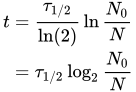
where is the half-life of the element, is the time expired since the sample contained the initial number atoms of the nuclide, and is the remaining amount of the nuclide. We can measure directly, for example by using a radiation detector, and obtain a good estimate of by analyzing the chemical composition of the sample. The half-life , specific to each nuclide, can be accurately measured on a pure sample, and is known to be independent of the chemical composition of the sample, temperature and pressure.[1] Solving for gives us the estimated age of the sample:


Example Problem[edit]
Through analysis, a bone fragment is determined to contain 13% of its original carbon-14. The half-life of carbon-14 is approximately 5,730 years. Approximately how old is the bone?
Since the quantity represents 13% (or 13/100ths) of , it follows that
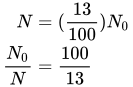
Using the formula above:
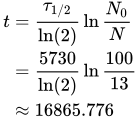
Thus the bone is approximately 17,000 years old. (Our input data had two significant figures, so reporting a more accurate result would be meaningless.)
Types of dating[edit]
Carbon-14 dating[edit]
Rubidium-strontium dating[edit]
This is based on the decay of rubidium isotopes to strontium isotopes, and can be used to date rocks or to relate organisms to the rocks on which they formed. It suffers from the problem that rubidium and strontium are very mobile and may easily enter rocks at a much later date to that of formation.[2][3]
Potassium-Argon dating[edit]
This method for rock dating is based on the decay of potassium-40 into argon: until the rock solidifies, argon can escape, so it can in theory date the formation of rock. One problem is that potassium is also highly mobile and may move into older rocks.[3]
Uranium-lead dating[edit]
This depends on the decay of uranium-235 and uranium-238 to isotopes of lead. Due to the long half-life of uranium it is not suitable for short time periods, such as most archaeological purposes, but it can date the oldest rocks on earth.[4]
Samarium-neodymium dating[edit]
This method has the benefit of samarium and neodymium both being chemically similar rare earth metals, and thus being unlikely to ever physically separate. However, since samarium-137 has a half life of over 100 billion years, it is mostly used for dating meteorites.[5]
Limitations of radiometric dating[edit]
A important limitation of radiometric dating often overlooked by layman (and not always made clear in scholarly works as well) is that any date is actually a range, following the 68–95–99.7 rule.
A proper radiometric date should read years before present (with 1950 being present) ± range/2 at x standard deviations (Xσ)', but is often reported as a single year or a year range, like 1260–1390 CE (the date for the Shroud of Turin). This leaves out important information which would tell you how precise is the dating result.
Carbon-14 dating has an interesting limitation in that the ratio of regular carbon to carbon-14 in the air is not constant and therefore any date must be calibrated using dendrochronology. Another limitation is that carbon-14 can only tell you when something was last alive, not when it was used.
A limitation with all forms of radiometric dating is that they depend on the presence of certain elements in the substance to be dated. Carbon dating works on organic matter, all of which contains carbon. However it is less useful for dating metal or other inorganic objects. Most rocks contain uranium, allowing uranium-lead and similar methods to date them. Other elements used for dating, such as rubidium, occur in some minerals but not others, restricting usefulness.[3]
Note that although carbon-14 dating receives a lot of attention, since it can give information about the relatively recent past, it is rarely used in geology (and almost never used to date fossils). Carbon-14 decays almost completely within 100,000 years of the organism dying, and many fossils and rock strata are hundreds of times older than that. To date older fossils, other methods are used, such as potassium-argon or argon-argon dating.
Other forms of dating based on reactive minerals like rubidium or potassium can date older finds including fossils, but have the limitation that it is easy for ions to move into rocks post-formation so that care must be taken to consider geology and other factors.[3] Whether results appear older or younger will depend on the contaminant and the dating method.
Radiometric dating and YEC[edit]
Radiometric dating — through processes similar to those outlined in the example problem above — frequently reveals that rocks, fossils, etc. are very much older than the approximately 6,000 to 10,000 years reckoned by young earth creationists. The oldest rock so far dated is a zircon crystal that formed 4.4-billion-years ago, which was only 200 million years or so after the Earth itself formed. [6] YEC biblical literalists are necessarily bound to the dogmatic religious conclusion that the Earth is of a certain age based on a particular literal interpretation of the Genesis creation myth. They tie themselves in logical knots trying to reconcile the results of radiometric dating with the unwavering belief that the Earth was created ex nihilo about 6,000 to 10,000 years ago. Creationists often blame contamination.
Indeed, special creationists have for many years held that where science and their religion conflict, it is a matter of science having to catch up with scripture, not the other way around.[7][8][9]
One way Young Earth Creationists and other denialists try to discredit radiometric dating is to cite examples of radiometric dating techniques providing inaccurate results. Frequently, in such examples, the selected technique is used outside of its appropriate range, for example on very recent lavas. In attempting to date Mt. St. Helens, creationists attempted to discredit the discipline through dishonest practices.[10] The Institute for Creation Research's RATE project aimed to show scientifically that methods of radiometric dating produced wildly inconsistent and incorrect values. Ultimately these "creation scientists" were forced to admit that even for methods they accepted as sound, the age of the Earth would be vastly greater than the 6,000 they set out to prove.[11]
Creationists commonly object to carbon dating results on the basis that they can be contaminated in the laboratory by atmospheric carbon; however such contamination would result in increased carbon-14 levels and hence the object appearing younger than it is; hence samples can only be older than they appear, not younger, which does not help young earth creationists at all.[12] With other dating methods, results would vary.
Is radioactive decay constant?[edit]
Another creationist argument is to claim that rates of atomic decay are not constant through time.[13] If there was substantial variation, it would indeed be a problem. An enormous amount of research shows that in the lab decay rates are constant over time and wherever you are. Faced with this, creationists say that you can't extrapolate from this to deduce they are correct over billions of years.[13] This ignores the fact that over periods of thousands of years (used by carbon dating), dating can be calibrated using other methods like dendrochronology, ice cores, and historical records.
A few experiments have found small variations in decay rates, at least for some forms of decay and some isotopes.[14] In particular, research at Geological Survey of Israel found periodic variations in the decay of radon of up to 4%, although other research, such as a study on cesium at Gran Sasso, found no variation.[15] A 2017 study looking at various isotopes found no significant evidence of periodic variation.[16] If the phenomenon is real, any mechanism is unclear (a solar influence is tentatively suggested, although the variability in results between experiments means a local cause may be more likely). While it may require further investigation to see if this is a real phenomenon, even the biggest positive results do not offer anything like a variation that would allow the truth of young earth creationism.
Another thing (willfully) overlooked by YECs is that radiometric dating is relative. Whatever the rate of decay might have been at various points through time, the older the object, the more advanced the radioactive decay will be. If, for example, dinosaurs coexisted with humans, one would expect to find dinosaur remains more recent than the oldest human remains. No such remains have been discovered.
See also[edit]
- Carbon dating
- Dendrochronology
- 101 evidences for a young age of the Earth and the universe
- Evidence against a recent creation
- RATE
External links[edit]
References[edit]
- ↑ The exception are the nuclides decaying via electron capture, where the half-life is marginally dependent on pressure and chemical bonds.
- ↑ Rubidium–strontium dating
- ↑ 3.0 3.1 3.2 3.3 Radioactive dating, Australian Museum, New South Wales
- ↑ Uranium–lead dating
- ↑ Sm–Nd Dating, Richard W. Carlson, SpringerLink, 3 February 2014
- ↑ Crystal is 'oldest scrap of Earth crust'
- ↑ See, e.g., Science in the balance: "If the Bible says something happened, we are to believe it, up front, right away, without hesitation. We are to teach what the Bible says and let scientific research and discovery catch up to the truth of Scripture. Science is not a priority tool of biblical interpretation. … Science is a powerful, God-given tool, but only the Bible is true in every aspect; the text trumps any theory of science. Its truth does not wait for verification from us."
- ↑ See also, Geochronology kata John Woodmorappe by Steven Schimmrich, Woodmorappe Replies to Steven Schimmrich's "Geochronology kata John Woodmorappe" by "John Woodmorappe," and Schimmrich Responds to John Woodmorappe's rebuttal by Steven Schimmrich for a revealing exchange between a Ph.D. Structural Geologist and a well-known creationist crank long engaged in unsuccessfully attempting to debunk methods of radiometric dating.
- ↑ See also, Dr Kevin R. Henke exposes John Woodmorappe's fraudulent attacks on radiometric dating and reveals other creationist misrepresentations.
- ↑ Kevin R. Henke. "Young-Earth Creationist 'Dating' of a Mt. St. Helens Dacite: The Failure of Austin and Swenson to Recognize Obviously Ancient Minerals". No Answers in Genesis.
- ↑ Assessing the RATE project by Randy Issac
In this book, the authors admit that a young-earth position cannot be reconciled with the scientific data without assuming that exotic solutions will be discovered in the future
- ↑ How Good Are Those Young-Earth Arguments?, Dave E Matson, talkorigins.org
- ↑ 13.0 13.1 Radiometric Dating: Problems with the Assumptions, Answers in Genesis
- ↑ Radioactive decay
- ↑ Analysis of Gamma Radiation from a Radon Source: Indications of a Solar Influence, P. A. Sturrock, G. Steinitz, E. Fischbach, D. Javorsek, II, J. H. Jenkins, arXiv, May 2, 2012
- ↑ Is decay constant?, S. Pommé et al, 7 September 2017, https://doi.org/10.1016/j.apradiso.2017.09.002