
Biblical literalism

| Light iron-age reading The Bible |

|
| Gabbin' with God |
| Analysis |
| Woo |
| Figures |
“”If you just close your eyes and block your ears
To the accumulated knowledge of the last two thousand years Then morally, guess what? You're off the hook And thank Christ you only have to read one book |
| —Tim Minchin, The Good Book[1] |
There is debate among Christians about how The Bible should be best interpreted.
Biblical literalism is the theological view held by one group of Christians that one should regard the contents of the Bible[note 1] as literally true and "inerrant". The text is not (according to this view) to be interpreted[2] as allegory, or mythology, and is without fault in its claims, unimpeachably true in all matters. Literalism provides the bedrock for several different pseudoscientific positions, such as young-Earth creationism,[3] deluge theory,[3] geocentrism, and flat-Earthism. Biblical literalism, as applied in history, has also justified slavery,[4] as well as bolstering racial segregation,[4] Jim Crow laws,[5] and Apartheid (Acts 17:26).[6] Biblical literalists can find support both for monarchies[7] and for theocratic republics.[8] Take your pick.
A belief in Biblical literalism requires one to ignore or deny huge amounts of modern science and its supporting evidence, and to replace provable, rational explanations with various versions of 'Goddidit'. In short, it requires you to be a blithering moron.
Non-literalist Christians would maintain that insistence on a simple literal meaning may obscure the larger points that they claim the scriptures may convey: such as somewhat dubious moral lessons or evidence of their versions of God's mercy. Christian belief in literalism often involves an appeal to a 'common-sense' interpretation of the Bible that anyone can see for themselves, while at the same time promoting an official literal interpretation from religious authority.[4] (After all, some Biblical passages can seem obscure, millennia after their original composition.) Even ignoring the hypocrisy of claiming individually-interpreted literalism while promoting an official party line of literalism, other problems of Biblical literalism include:
- Reliance on (for example) the King James Version of the Bible and ignoring the numerous problems with Bible translation (languages other than English may use their respective traditional translations in lieu of alternative ones)
- Lack of understanding by lay readers
 of the cultural contexts in which individual Bible texts were written or set (while often accusing critics of taking Bible verses out of context)
 - Cherry picking[9] which passages of the Bible to take literally and which to take metaphorically
- Ignoring contradictions within the Bible itself
- The interpretation not jibing with reality
Recent Gallup polling (2017) seems to suggest that Biblical literalism is slowly declining in the USA in favour of the more rational belief that the Bible consists of "fables, legends, history, and moral precepts recorded by man".[10]
There are other groups of people who may read the bible literally: non-Christians and atheists, including former Christians on both. Whereas Christian literalists read the Bible literally and maintain it's literally true; this second group reads the Bible literally and maintains it's largely nonsense.
Literalism vs inerrancy vs infallibility[edit]
“”Ah, yes — sometimes the Bible is the word of God. Sometimes it's the word of man. And sometimes, it's the word of two or more men. Sometimes the Bible's literal, and sometimes it's simply symbolic.
|
| —Penn Jillette, in response to Christians who try to both eat and have their literalism cake at the same time[11] |
It is important to distinguish between the related but separate concepts of Biblical literalism, Biblical inerrancy, and Biblical infallibility. Some are used interchangeably depending on whom you ask. But, going by strict definitions for reasons of precision, they are different — many doctrinal bases or confessions for churches and organised sects require adherents to view the Bible as "inerrant" but do not support literalistic interpretations like creationism.
- Self-interpretation: The most extreme form, this argues that there is a singular true meaning which will be made evident to any "real" believer by simply reading the text. This typically forms an excessively text-literal reading which treats the text as though it were scientific data; all apparent contradictions will be held to be factual and "harmonized" with this in mind. This attitude may regard a specific translation as the only correct one (for example, Jack Chick regarded only the King James Bible as truthful). It is often criticised by less insane literalists as worshipping the Bible instead of God.
- Biblical literalism: A literalist approach means that one reads the Bible in a plain and straightforward manner, attempting to discern the author or authors' original intent. Biblical literalists believe that the original authors of the Bible were inspired by the Holy Spirit and drafted scripture in various literary genres and styles of the period. Thus, Biblical literalists accept that, for example, poetry and allegory in the Bible are literally true, but may not necessarily be written as a historical document. They examine the circumstances of scripture to determine how it should be understood. One big problem with literalism is that two people may read the literal meaning of a phrase differently. eg. When Jesus said that "the only way to the Father is through (Greek: δι’) me",[12] was he literally telling us to find His body and to bring a big knife for cutting open a hole in it?
- Biblical inerrancy: This is the basis that the Bible simply doesn't contain any errors. There is a subtle but important difference between this and historical accuracy, as stories can be interpreted as allegorical, but their meanings remain true. It also differs from literalism in that it allows for the Truth to be conveyed via poetry, metaphor, and implication.
- Biblical infallibility: The least radical position. It holds that the Bible is an infallible source regarding questions of faith and redemption, but not on questions of science and history. These people may be willing to accept scientific facts like evolution as true.
The actual interpretation of these questions further depends on the various denominations and theological schools of thought.
Other views[edit]
“”They're making the mistake of linking their belief in faith, in their religion, to actual factual tenets. These are not factual stories to be taken as historical events, they're really stories about how we should live our lives. They're moral homilies. What can I personally get out of the Bible for me, today. That's what those stories are about. And to take them literally is; you're missing the point of the Bible!
|
| —Michael Shermer[11] |
Many Christian groups, such as the Catholic Church, hold that the Bible is inerrant in its spiritual and moral teachings, but can be inaccurate as far as history goes. In contrast to that position, Biblical literalists hold that the Bible reports true history from Genesis onward.
Some Christians would argue that it is a necessary fact of life that doubting one's own religion and all the things learned from one's family is the most important step one can take to living the life of a model Christian.
Many educated Christians who do not believe in Biblical literalism would maintain that interpreting the Bible literally, and therefore giving the genocidal tendencies of the Old Testament precedence over the love and compassion of Jesus Christ in the New Testament, is fundamentally wrong. Some would go even further to say that the center of one's faith should be Jesus Christ, as illuminated by the Bible. Making the Bible the center of one's faith, rather than Jesus and his commands to love and care for humanity, is therefore a form of idolatry, and deeply sinful.
Problems abound[edit]
“”It's mythic storytelling and nothing more. The more we learn about archeology and history in biblical times, the more we realize that most of the stuff in the bible is fiction.
|
| —Michael Shermer[11] |

There are numerous problems with Biblical literalism.
Science[edit]
The first and most obvious problem with Biblical literalism is that science has utterly and completely falsified it where it makes statements about the natural world. We now know that the earth is far older than 6,000 years, that the many species of life developed slowly through the mechanisms of evolution, and that familiar spirits and wizards — which the Bible refers to as though they are real[13] — have no influence on the world, if they even exist at all.
However, Biblical literalists have not gotten rejected this memo on the grounds that it demolishes their worldview and have sent out bands of so-called creation scientists to slap a 'scientific' veneer on interpreting the Bible literally and impugn, without grounds, the integrity of actual scientists.
Hud Hudson has argued that if one assumes time is made of various blocks that can be separated into different slices and that physical laws can vary between blocks (the hypertime hypothesis), then it might be possible for God to move a slice containing Adam and Eve from a block where the world was created as described in Book of Genesis to the block we're in right now. In this way, modern science holds true, but literal reading of Genesis is still possible. The rub is that this argument rests entirely on hypertime hypothesis being true, which isn't necessarily bad in and of itself, but the hypothesis is rather difficult to falsify, and it's just one metaphysical hypothesis out of many.[14]
Cryptids[edit]
Several cryptids (animals for which no extant evidence of their existence have yet been found or proven) appear in the Bible. Literalists could perhaps claim that they once existed but that their fossils have not been found yet, which would be their most plausible rationalization. Of the cryptids, the dragon is the only type to appear in the New Testament (Revelation and Ephesians). With the issue of literalism comes the question of which literalism? Unless one is a nonsensical King James Only literalist (basically believing that God failed to dictate correctly the first time around), the issue of literalism for the KJV Old Testament books boils down to what was meant in the original Hebrew books.
- Behemoth appears in Job 40:15-24 ("… He moveth his tail like a cedar: the sinews of his stones are wrapped together. His bones are as strong pieces of brass; his bones are like bars of iron. … Behold, he drinketh up a river, and hasteth not: he trusteth that he can draw up Jordan into his mouth.")
- The behemoth is plausibly an elephant, or perhaps a hippopotamus[15] from this description, but the word 'behemoth' derives from the Hebrew b'hēmōth (בְ֭הֵמוֹת), which simply translates as 'beast', but likely is derived from the Egyption p-ehe-mau, meaning 'water-ox'.[16]
- Cockatrice appears in Isaiah 11:8, Isaiah 14:29 ("…for out of the serpent's root shall come forth a cockatrice, and his fruit shall be a fiery flying serpent."), and Isaiah 59:5. The term 'cockatrice' was a Middle Ages translation of the Latin basiliscus and ancient Greek βασιλίσκος (hence synonymous with 'basilisk'[17]) that appeared in the Septuagint.[18] The Hebrew word for viper (ṣe-p̄a‘, or צֶ֔פַע)[19] had been transformed into basiliscus, but describing the viper as a "fiery flying serpent" makes it impossible to reconcile with biological reality.
- Dragon: Appears in multiple books: Revelation, Isaiah, Job, Malachi, Micah, Ephesians, Ezekiel, Nehemiah, Jeremiah, Psalm, and Deuteronomy. Among the cryptids of the Bible, the dragon is perhaps the most troublesome to resolve because of the post-Biblical Christian legend of Saint George and the Dragon, which would have taken place within the lifetime of George of Lydda, who died in 303 CE. There should have been contemporaneous non-Christian accounts by historians of actual dragons at that time, or at least non-fossilized dragon bones, but none exist.
- Leviathan appears in Job 41:1-34, and lays out the many ways in which the leviathan, a creature of the sea cannot be killed. Leviathan also appears in Isaiah 27:1 ("…leviathan the piercing serpent, even leviathan that crooked serpent; and he shall slay the dragon that is in the sea."), Psalm 74:14, Psalm 104:26 ("There go the ships: there is that leviathan, whom thou hast made to play therein."). The word 'leviathan' derives from the Hebrew livyāthān (לִוְיָתָ֣ן).[20]
- Phoenix: The phoenix appears in the Septuagint in Job 29:18 ("I shall die with my nest, and I shall multiply my days as the phoenix"), but not in the KJV or other Christian versions of the Old Testament.[21]
- Satyr appears in Isaiah 13:21 ("…and owls shall dwell there, and satyrs shall dance there.), Isaiah 34:14. The Latin word satyrus and ancient Greek σάτυρος (referring to any wood spirits) was used to translate the original Hebrew śāʿīr, which more accurately refers to "goat-like desert spirits or demons."[22]
- Unicorn appears in Isaiah 34:7 (in the KJV at least), Job 39:9-10, Numbers 23:22, Numbers 24:8, Psalm 22:21, Psalm 29:6, and Psalm 92:10. Unicorn is a translation of the Latin ūnicornis and Greek μονόκερως. In the original Hebrew, however, the word re'em (רְאֵ֖ם) was used, which meant 'wild-ox'.[23][24]
- Ziz: Psalm 50:11, Psalm 80:13-14 The ziz (Hebrew: זיז) was replaced in the KJV with the word 'beast'.[25] Ziz is comparable to the Persian simurgh, the Sumerian anzû, and the Greek phoenix.[25]
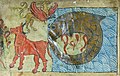
Behmoth (left), leviaithan (right), and ziz (top): from a 1238 CE Bible
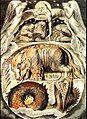
William Blake's painting of Heaven above Behemoth above Leviathan

A cockatrice building ornament (1869 CE)

Dragon from the 1534 CE Luther Bible

Goat with Greek satyr (c. 520 BCE). Greek satyrs were typically depicted with erections.

The English coat of arms, created during the reign of King James, unicorn on the right


.svg)
Non-historicity[edit]
“”And who is so foolish as to suppose that God, after the manner of a husbandman, planted a paradise in Eden, towards the east, and placed in it a tree of life, visible and palpable, so that one tasting of the fruit by the bodily teeth obtained life? and again, that one was a partaker of good and evil by masticating what was taken from the tree? And if God is said to walk in the paradise in the evening, and Adam to hide himself under a tree, I do not suppose that anyone doubts that these things figuratively indicate certain mysteries, the history having taken place in appearance, and not literally
|
| —Origen, early church father[26] |
Here is a piece of historical revisionism. Biblical literalists insist upon a literal interpretation of Genesis: "Genesis 1:11 is factual."[27] Yet a number of Church Fathers, including Saint Augustine, have gone on record as not interpreting Genesis literally, and orthodox Christians were apparently free to disagree on the matter.[28] Had Biblical literalism been so "integral" to the Church in those early days, the body of righteous faithful would have branded those men as heretics, instead of commemorating them as Church Fathers and canonizing most of them. Not even the Reformers took the Bible in the most literal sense; certain Calvinist writers used an allegorical method of interpretation.[29]
Advocates of the Bible as a literal history-book may overlook the actuality of history-writing in antiquity. History as understood in the 21st century — comprising verifiable accounts of events analyzed and interpreted with balance and with caution — hardly existed before the 18th century. On the other hand, ancient history writing largely included:
- Believe-it-or-not travelers' tales (like those of Herodotus)
- Moralizing literary concoctions (like those of Polybius or of Suetonius)
- Hagiographical biography (like the lives of Alexander or of Agricola)
- Myths and legends (like those of Homer or of Livy)
As a product of the ancient era, the "history" in the Bible texts (as opposed to (for example) laws and prophecies) broadly resembles:
- Believe-it-or-not travelers' tales (like those about Jonah or Balaam's ass)
- Moralizing literary concoctions (like those of Paul and Peter)
- Hagiographical biography (as in the canonical Gospels)
- Myths and legends (like those recounting the origins of the universe, the origins and experiences of the Hebrew people, and the deeds of Jesus and of his followers)
All part of the literary history genre, but little of it literal history.
Biblical position[edit]
“”What has always happened (so far) is that when science has asserted something inconsistent with religious doctrine, eventually the doctrine has changed. It does not happen that some method of religious inquiry is undertaken that resolves the problem; instead, there is a process of reinterpretation. Whereas the early Catholic Church believed that geocentrism was essential to Christian doctrine, now the [C]hurch has found a way to interpret its scriptures less literally. It is to be hoped that the idea of a literal six-day creation is similarly on its way out (as most branches of Christianity have already decided).
|
| —Mark Owen Webb[30] |
The Bible does not refer to itself as a unit, nor could it possibly do so, since its most recent books date from generations before certain church councils assembled and winnowed the canon of scripture. The closest that the Bible comes to self-referentiality and claims of inerrancy is, for example, 2 Timothy 3:16-17, which reads "All Scripture is breathed out by God and profitable for teaching, for reproof, for correction, and for training in righteousness, that the man of God may be competent, equipped for every good work" (ESV). Note, first, that "Scripture" in this passage refers to, at most, the old Jewish canon, and second, that it says nothing of inerrancy or any similar concept. Going from "breathed out by God" to "without error in a single detail" is a logical leap made in relatively recent times. Should an omnipotent deity have wanted to establish a doctrine of inerrancy, the passage from 2 Timothy above could easily have indicated that "Scripture is inerrant and should be regarded as fully accurate in every historical detail", rather than making a general statement about scripture (however defined) being "profitable" or "useful".
In addition, the phrase "word of God" in reference to the Bible is a recent and extra-biblical concept. "Word of God" appears in the Gospel of John where it refers to God or to Jesus, not to the Bible or to any previously-compiled canon of scripture.
Saint Paul (who had some first-hand experience of writing inspired sacred texts) states: "the letter killeth, but the spirit giveth life" (2 Corinthians 3:6). Should we take this Biblical statement literally? Biblical literalists' advocacy of the "letter" of scripture has a chilling effect, whereas a bit of inspired metaphorical interpretation livens things up. Cue the hermeneutics of Origen.
Biblical claim of potential for error[edit]
“”The authority of Scripture is inescapably impaired if this total divine inerrancy is in any way limited or disregarded, or made relative to a view of truth contrary to the Bible's own.
WE AFFIRM that the doctrine of inerrancy has been integral to the Church's faith throughout its history. WE DENY that inerrancy is a doctrine invented by scholastic Protestantism, or is a reactionary position postulated in response to negative higher criticism. |
| —Chicago Statement on Biblical Inerrancy[31] |
While there is no Biblical suggestion that the Bible as it was revealed contained errors, there is explicit mention made of the potential for man to add to or take from God's words, or at least his words in the book of Revelation (see also above). Revelation 22:18-19 reads:
I warn everyone who hears the words of the prophecy of this scroll: If anyone adds anything to them, God will add to that person the plagues described in this scroll. And if anyone takes words away from this scroll of prophecy, God will take away from that person any share in the tree of life and in the Holy City, which are described in this scroll.[32]
If these are part of the original, divinely inspired text, then they indicate that man could potentially alter the Bible; if they are not, they indicate that man did alter the Bible at some point as has been claimed to be the case with such verses having been added by later amanuensis to ensure future copiers would not mess with the texts.
Note that no less a theologian than Martin Luther advocated altering the Bible by (for example) demoting the book of Revelation from the canon. About this, pastor Mal Couch of the Tyndale Theological Seminary writes:
Another section, which [Luther] placed in the back of his Bible, included the New Testament works he felt had relatively little value (Hebrews, James, Jude, and Revelation). With reference to these four books, Luther said, 'They have from ancient times had a different reputation' and therefore should not be included with the 'true and certain chief books of the New Testament.' […] In reference to Revelation, Luther wrote in 1522 that he could find 'no trace' of evidence that the book 'was written by the Holy Spirit.' In other words, he rejected its divine inspiration.[33]
Biblical canon[edit]
“”WE DENY that Church creeds, councils, or declarations have authority greater than or equal to the authority of the Bible.
|
| —Chicago Statement on Biblical Inerrancy[31] |
It is all very well to say, "The Bible is without error." But then comes the question, What is the Bible? Since the Bible is made up of numerous books, rather than a single unit, which books are literally true is a big deal.[34] The Biblical canon has been anything but fixed. As noted above, in the Apostolic Age, there was really no Bible to speak of apart from the old Jewish canon; significant disputes over canonicity were not settled until a few centuries later, and they were not settled by "the Bible," but by ecumenical church councils.
Then at the Protestant Reformation, seven entire books not in the Hebrew Bible were cut from the canon. Martin Luther cut four more (Hebrews, James, Jude, and Revelation) mostly due to verses within them that contradicted his theological views.[35]
What, then, is the Bible? Were the Reformers right in cutting the deuterocanon? Was Luther right in his cuts? This seems to throw the whole concept of Biblical inerrancy into question by introducing a factor of fallible human judgment. If a book is erroneously included in the canon, literalists are material heretics; if a book is erroneously excluded, literalists are denying the inerrancy of a part of the Bible and hence the concept of Biblical inerrancy becomes useless.
Indeed, as church father Augustine of Hippo himself concluded on the question of Biblical inerrancy, in a letter to Saint Jerome:
On my part I confess to your charity that it is only to those Books of Scripture which are now called canonical that I have learned to pay such honour and reverence as to believe most firmly that none of their writers has fallen into any error. And if in these Books I meet anything which seems contrary to truth, I shall not hesitate to conclude either that the text is faulty, or that the translator has not expressed the meaning of the passage, or that I myself do not understand.[36]
The Catholics and Eastern Orthodox answer these questions thus: there is a concept of a "Holy Tradition" that is maintained within the church. Holy Tradition is put on par with the Bible in terms of authority, and the Biblical canon is part of that tradition.
However, the Biblical literalists have rejected this concept of tradition. As the Chicago Statement itself says, "The Church's part was to discern the canon God had created" — and the Church, by the literalists' own admission, was perfectly capable of going wrong on this. In some sense, creating an errant Bible with inerrant contents.
You can read more at our main article, Apocrypha.
Metaphorical verses[edit]
“”If any man come to me, and hate not his father, and mother, and wife, and children, and brethren, and sisters, yea, and his own life also, he cannot be my disciple.
|
| —Some guy who didn't know the Bible was meant to be taken literally[37] |
Some Biblical verses - and phrases, and words - are meant to be metaphorical; some are not. How can a Biblical literalist tell the two apart?
As a special case of the above problem with interpretations, there is a problem with deciding what passages were meant to be taken literally and which passages were not. The Chicago Statement acknowledges that many parts of the Bible are not intended to be taken literally: "A parable, for example, should not be treated like a chronicle, nor should poetry be interpreted as though it were a straightforward narrative."[27]
But what is to be read straight and what is to be read as a poem, allegory, etc.? Literalists (e.g., Philip J. Rayment of A Storehouse of Knowledge[38][39]) claim that it is "clear" or "obvious" what is meant to be taken literally and what is not; in the Chicago Statement, this is expressed as support for "genre criticism," or systematic attempts to determine which verses belong to which literary genres. (Of course, like any language, Biblical language can switch genres in a trice, make jokes, and hint at implications and connotations. Poetic imagery can sneak in anywhere. It's complicated...)
Unfortunately for the people who claim "clarity" or "obviousness", while genre criticism has shed some light on the matter, there is vast disagreement about what is literal and what is not. An example is the Book of Revelation: while most Christians, including some literalists, view Revelation as being obviously allegorical and using "apocalyptic symbolism",[38] other literalists propagate New World Order conspiracy theories in which they claim that the Antichrist will soon be introducing a cashless economy, in which people will have to pay for things via an implant that will take the form of "a mark in their right hand, or in their foreheads" (Revelation 13:16).
The problem of delineating the metaphorical parts of scripture from the literal ones applies to most any religion with its own scripture, and the tendency on the part of apologists toward moving the goalposts when faced with this problem was notably parodied by Zach Weiner of Saturday Morning Breakfast Cereal.[40] Though he does not unambiguously reference a specific religion, he does encapsulate the issue nicely.
Fixity of the Earth[edit]
Take the year 1500 CE as a rough division line. Before that date, no one suggested that references to the fixity of the Earth and the motion of the Sun were figurative. Everybody thought that the Sun went around the Earth daily, just as the Bible clearly states in (for example) Psalm 19:6. After a somewhat tumultuous transition period, during which those who thought that it just might be figurative language in the Bible were often in trouble for suggesting that, it turns out that just about everybody — except for modern geocentrists — agrees that the Earth is a planet, and that the Biblical language is, after all, not literal. It may indeed have been intended as figurative, but it is difficult to maintain that it is "clear" or "obvious" if everybody, for 2000 years or more (from the first Biblical readers in 500 BCE or earlier up to 1500 CE, not to mention today's modern geocentrists), thought it was literal.
HolySpiritDidIt?[edit]
“”WE AFFIRM that a person is not dependent for understanding of Scripture on the expertise of biblical scholars.
WE DENY that a person should ignore the fruits of the technical study of Scripture by biblical scholars.[27]
|
Norman L. Geisler, one of the signatories of the Chicago Statement on Biblical Hermeneutics, expounds on the above position as follows, revealing it to have a political rather than a doctrinal basis, rather like the rationale behind the Conservative Bible Project (complete with scare quotes around experts):
One is not dependent on biblical "experts" for his understanding of the basic truths of Scripture … For if the understanding of the laity is contingent on the teaching of experts, then Protestant interpretive experts will have replaced the teaching magisterium of Catholic priests with a kind of teaching magisterium of Protestant scholars.[27]
With that in mind, there are at least two problems with this idea.
Firstly, if one looks at this from any sort of rational perspective, one can see that of course the layman needs the help of experts to understand the Bible; if one just picked up a copy of the Bible he found in the wilderness and read it cover-to-cover (something that few will do, and some cannot do), current doctrinal positions are the product of two millennia worth of theological thought, which the isolated Bible reader could not replicate in his own head, even allowing that most of that theology is based solely in the Bible. It is not: one must have at least some background in Western philosophy and the history of the times to do that properly.
Some Biblical literalists will respond to such criticisms by saying "HolySpiritDidIt": the Holy Spirit is said to fill the gaps to enable any person to understand the Bible. The Chicago Statement frames this as:
The Holy Spirit, Scripture's divine Author, both authenticates it to us by His inward witness and opens our minds to understand its meaning.[31]
However, the Bible itself is the ultimate means of support for such claims, introducing an element of circularity: one still needs experts to tell him that "HolySpiritDidIt."
However, even if HolySpiritDidIt, there is a second problem with this position, at least with regard to the Old Testament: historically, nobody interpreted the Bible independently of a body of experts. Before Jesus's time, the Jews maintained much of their religious law in an oral tradition of commentaries that was only codified into the Talmud several centuries after Jesus's death as a response to the destruction of the Second Temple. In Jesus's time the "scribes and Pharisees" were responsible for debating and teaching the law to the people, and although Jesus denounced the hypocrisy of these experts, he acknowledged (Matthew 23:3) that they taught the law correctly. From the Apostolic Age up until the Protestant Reformation, similarly, in both Catholicism and Eastern Orthodoxy there were ecumenical councils to settle theological disputes and an idea of "Holy Tradition" in the church, independent of the Bible.
There is a third (albeit slightly weaker) point to be made: to suggest that the Holy Spirit is necessary to understand the bible seems to imply that the bible is not literally true after all. Instead, this would mean that the composite of what is in the bible and what the Holy Spirit makes you understand is literally true as a combined unit. But of course, since the Holy Spirit speaks to individuals (as opposed to a world wide broadcast), we are still left with what amounts to individual interpretation of the bible, or at the very least a homunculus fallacy.
Problematic "self-interpretation"[edit]
| —Chicago Statement on Biblical Inerrancy |
“”The very same Bible — which biblicists insist is perspicuous and harmonious — gives rise to divergent understandings among intelligent, sincere, committed readers about what it says about most topics of interest. Knowledge of "biblical" teachings, in short, is characterized by pervasive interpretive pluralism. … In a crucial sense it simply does not matter whether the Bible is everything biblicists claim theoretically concerning its authority, infallibility, inner consistency, perspicuity, and so on, since in actual functioning the Bible produces a pluralism of interpretations.
|
| —Christian Smith[41] |
In line with Biblical literalists' political objection to the idea that experts are needed to interpret the Bible, they hold that the Bible has only one correct interpretation and that this interpretation is self-evident. Contrast this view with the more flexible methodology of higher criticism, which seeks to understand scripture within the historical context of its original meaning to the author and recipients, rather than treating scripture as divinely inspired and incapable of error. Where literalists treat scripture as revelation, scholars employing higher criticism aim to treat it as an historical document.
Analyzing the Bible in its original languages and taking into account historical context can lead to literal readings that differ from what is "self-evident" in the text. For example, the "Clobber Passages" (such as 1 Corinthians 6:9-11) are often cited as proof of the Bible's absolute and enduring intolerance of homosexuality. In most English translations, these passages leave no room for flexibility or metaphorical interpretation, hence their use by Biblical literalists to "clobber" openly queer people who dare believe they were created in God's image (as per Genesis 1:27).
However, the modern concept of sexual orientation did not exist in Biblical times,[42] and a literal reading of the Clobber Passages in the Old Testament shows them to condemn homosexual acts as ritually unclean behavior (using the same Hebrew word, to'ebah, that disparages mixed cloth and menstruating women).[43] In the New Testament, Paul condemns gay sex as a form of idolatry (Romans 1) as it was then associated with pagan temple prostitution. Instead of using the common Greek word for men who have sex with males (paiderasste) he uses the neologism arsenokoitai, which has been interpreted over centuries as anything from a sex offender to male prostitute to masturbator.[44]
Biblical literalists who extend these passages to condemn modern queer identities and relationships (which are not described in the Bible) are in actuality opting for a non-literal interpretation of the texts.
The Bible itself disagrees with any rigid approach to interpreting it according to some "self-evident" literal meaning.
Genesis 16-17 relates the story of a love triangle between Abraham, his wife Sarah, and her handmaiden Hagar. Sarah appears to be sterile, and tells Abraham to have a child with Hagar, which he does. Some years later, God makes a covenant with Abraham in exchange for, among other things, a child with Sarah.
In Galatians 4, St. Paul assigns an entirely new allegorical or figurative interpretation to this story to go along with the literal one: Hagar's son Ishmael represents non-Christians in bondage to the Mosaic Law, while Sarah's son Isaac represents Christians freed from the law by the new covenant. So according to the Bible itself, at least some parts of it can be interpreted in non-self-evident ways unintended by their original authors.
Fr. John Whiteford, an evangelical who converted to Eastern Orthodoxy, had this to say about the idea that "Scripture is to interpret Scripture":
Protestants who are willing to honestly assess the current state of the Protestant world, must ask themselves why, if Protestantism and its foundational teaching of Sola Scriptura are of God, has it resulted in over twenty-thousand differing groups that can't agree on basic aspects of what the Bible says, or what it even means to be a Christian? Why (if the Bible is sufficient apart from Holy Tradition) can a Baptist, a Jehovah's Witness, a Charismatic, and a Methodist all claim to believe what the Bible says and yet no two of them agree what it is that the Bible says?[45]
Which rules?[edit]
“”This case is not about who is, or is not a fundamentalist. It is about people hiding behind a claim of reading the Bible literally, which nobody does anyway. A great example can be found among those who claim to follow every word of the Bible and use that claim to explain their rejection of homosexuality and witchcraft, but have no problem violating equally biblical bans on pork or cooking on the Sabbath.
Of course, they will point to a new scripture which extends the prohibition on the first two, and frees them from the second set of proscriptions. But that is an interpretive move and that means that they are no longer literalists[.]
|
| —Brad Hirschfield[46] |
The Bible has a great many rules, many contradictory. The only way to know which ones to follow (not eating pork, killing homosexuals) is to interpret the Bible. This means that people extend beyond mere literalism and enter into the field of Biblical criticism.
Theological warfare[edit]
In the best of traditions of internecine inter-Christian strife, Episcopal Bishop Emeritus John Shelby Spong makes the case for dismissing Biblical literalists as heretics.[47]
Claims of Biblical literalism[edit]
Numerous Christian organizations claim to take the Bible literally, although Answers in Genesis rewords "literally" as in a plain or straightforward manner.[48] But such claims cannot of course be true in all cases, since when it comes to what biblical passages the Answers in Genesis guys read in a straightforward manner, they are very picky. Who could even imagine them actually taking Jeremiah 17:10, Psalm 139:23, and Romans 8:27 literally? All three verses, read plainly, imply that God has to search out men's hearts in order to know them. Basically, the Bible suggests that the Biblical God is not omniscient, though any conservative Christian mother would love for her son to think this (to keep him from masturbating).
The same fallacious claim appears at the Got Questions website, an opponent of everything from carbon dating to human/chimp DNA evidence of the common ancestry which all primates share. The infallibly wise "Got Questions" authorities interpret Jacob's fight with Yahweh as some type of allegorical bullshit meant to remind Christians that though we may fight God and His will for us, in truth, God is so very good. As believers in Christ, we may well struggle with Him through the loneliness of night, but by daybreak His blessing will come.[49] Yeah right, Genesis chapter 32 is actually better interpreted as a remnant of the Yahwistic source, describing Yahweh as an anthropomorphic figure both physically (Genesis 3:8, Genesis 11:5, Exodus 17:7), or mentally (as when Abraham bargains with Yahweh for the fate of Sodom and Gomorrah, or when, during the Exodus, Yahweh, incensed by the Israelites' lack of faith, threatens to destroy them all and raise Moses' descendants instead but "relented and did not bring on his people the disaster he had threatened" when dissuaded by Moses).[50] Genesis chapter thirty-two, if anything, is just what it looks like: a story about Yahweh's bad-ass fight with Jacob.
Consequences[edit]
Unquestioningly accepting the Bible or large portions of it can have adverse effects.
While this doesn't disprove biblical literalism, it does make it very bad public policy.
Faith healing[edit]
Many children have died because their faith community believed prayer rather than medicine is what the Bible literally teaches.
For example, the Church of the First Born cites James 5:14:[51]
If any be sick, call for the elders of the church, let them pray over him, anointing him with oil in the name of the Lord.
This community rejects modern medicine but accepts computers and the Internet.
Unquestioning faith[edit]
People who adhere to literalism do not question their religion, tending towards a simplistic acceptance of what they are told. Though frequently literalists claim to have read the Bible, upon questioning it is clear they have rarely thought through the various positions proffered in it, including myriad inconsistencies or evidence that their God is capricious and violent. To hold such a position either requires a low IQ, a lack of education, or an overly developed reliance on cognitive dissonance which includes in the latter case claims about the Bible having to be read with the heart instead of with the mind.
One reason for biblical literalism is the need for consistency to protect ideas that are central to a religious ideology, thus preventing the believers of questioning their beliefs. For example, if one were to take the story of Genesis as being allegorical, then what is to stop that person from taking the words of Jesus and the Ten Commandments as being allegorical, and not the direct word of God? People thinking this way also tend to be the ones who try to find one single flaw in scientific theories such as evolution and declare that the single fault invalidates the entire system (which is a pure Achilles Heel fallacy), or for that matter use straw man versions of such theories to discredit them, without bothering to understand what such theories really say.
Necessary for salvation?[edit]
The Chicago Statement admits that belief in Biblical inerrancy should not be elevated to the level of a creed: "WE DENY that such confession [of Biblical inerrancy] is necessary for salvation."[31]
However, the statement also apparently contradicts itself by strongly implying that those who do not confess it are not saved: "The following Statement affirms this inerrancy of Scripture afresh, making clear our understanding of it and warning against its denial. We are persuaded that to deny it is to set aside the witness of Jesus Christ and of the Holy Spirit and to refuse that submission to the claims of God's own Word which marks true Christian faith."[31]
Biblical literalists have made clear, both in words and actions, that they have no problem with the idea that those who reject literalism are going to hell, and that any admission they make otherwise is lip-service to orthodoxy that they do not actually accept.
Disbelief in evolution[edit]
The writers of the Chicago Statement went out of their way to bash evolution by saying:
See also[edit]

|
For those of you in the mood, RationalWiki has a fun article about Proof the Bible is True. |
- Biblical contradictions
- Bibliolatry
- Biblical criticism
- Chicago Statement
- Clergy Letter Project — Denominations that sign this take the position that the Bible isn't meant to be taken literally like a science textbook, with the reasoning that the two serve different purposes. Acceptance of evolution is the main point of the project.
- Heaven#Heaven is hotter than Hell — the scientific and Biblical literalist approach to proving that Heaven is hotter than Hell
- Lane v. Sabine Parish School Board
- Chicago Statement on Biblical Inerrancy
- Chicago Statement on Biblical Hermeneutics
- Pharisee — the old school Biblical literalists who are described negatively in the New Testament
- God Hates Shrimp — if Biblical literalists were truly consistent
External links[edit]
- Why biblical inerrancy is critical; problems with biblical inerrancy at religioustolerance.org
Notes[edit]
References[edit]
- ↑ Tim Minchin - The Good Book (live w/Lyrics) (Dec 10, 2014) 'YouTube.
- ↑ See the Wikipedia article on hermeneutics.
- ↑ 3.0 3.1 Righting America at the Creation Museum by Susan L. Trollinger & William Vance Trollinger Jr. (2016) Johns Hopkins University Press. ISBN 1421419513.
- ↑ 4.0 4.1 4.2 Mississippi Praying: Southern White Evangelicals and the Civil Rights Movement, 1945-1975 by Carolyn Renée Dupont (2015). New York University Press. ISBN 1479823511.
- ↑ People of God: Segregation September 21, 2012 Central Seminary.
- ↑ The theology of apartheid by Ned Temko (June 12, 1986) The Christian Science Monitor.
- ↑ 1 Samuel 8:5-22
- ↑ Judges 2:16-18
- ↑ Dupont, Carolyn Renée (2015). "'Born of Conviction': The Travail of Mississippi Methodism". Mississippi Praying: Southern White Evangelicals and the Civil Rights Movement, 1945-1975 (reprint ed.). New York: New York University Press. p. 134. ISBN 9781479823512. Retrieved 4 June 2019. "Jim Waits, who pastored Epworth Church in Biloxi, agreed that 'the Bible is the Word of God,' but he condemned 'the selective picking and choosing of isolated texts to prove a point.'"
- ↑ Saad, Lydia (15 May 2017). "Record Few Americans Believe Bible Is Literal Word of God". Gallup. "Fewer than one in four Americans (24%) now believe the Bible is 'the actual word of God, and is to be taken literally, word for word,' similar to the 26% who view it as 'a book of fables, legends, history and moral precepts recorded by man.' This is the first time in Gallup's four-decade trend that biblical literalism has not surpassed biblical skepticism."
- ↑ 11.0 11.1 11.2 Penn & Teller: Bullshit!, S02E01, The Bible - Fact or Fiction
- ↑ John 14:6
- ↑ Leviticus 19:31
- ↑ The Fall and Hypertime by Trent Dougherty (August 6, 2015) Notre Dame Philosophical Reviews
- ↑ Could Behemoth Have Been a Dinosaur? by Allan Steel (August 1, 2001) Answers in Genesis (archived from 16 Dec 2016 13:30:02 UTC).
- ↑ behemoth, n., Oxford English Dictionary.
- ↑ "The Evolution of the Basilisk" by R. McN. Alexander (1962) Greece & Rome 10(2):170-181. doi:10.1017/S0017383500013589.
- ↑ cockatrice, n., Oxford English Dictionary.
- ↑ Isaiah 11:8 Bible Hub (archived from 16 Jun 2021 04:32:06 UTC).
- ↑ leviathan, n., Oxford English Dictionary.
- ↑ The Phoenix Bird Bible Study
- ↑ satyr, n., Oxford English Dictionary.
- ↑ unicorn, n. I.1.b. Oxford English Dictionary.
- ↑ Numbers 23:22 Bible Hub.
- ↑ 25.0 25.1 See the Wikipedia article on Ziz.
- ↑ The Ante-Nicene Fathers: Translations of the Wrigins of the Fathers down to AD 325 by Alexander Roberts & James Donaldson (1951) Wm. B. Eerdmans Publishing Company. Vol. 4, p. 365.
- ↑ 27.0 27.1 27.2 27.3 27.4 27.5 Chicago Statement on Biblical Hermeneutics with commentary by Norman L. Geisler. Reproduced from Explaining Hermeneutics: A Commentary on the Chicago Statement on Biblical Hermeneutics (1983) International Council on Biblical Inerrancy.
- ↑ Biblical Chronology by J. Howlett (1908) The Catholic Encyclopedia.
- ↑ A Study of Biblical Typology by Wayne Jackson, Christian Courier.
- ↑ Hizmet, Religious Knwoledge, and Scientific Eeducation by Mark Owen Webb (2016) Revista Brasileira de Ciências Sociais 31(90):9-16. doi:10.17666/31909-16/2016.
- ↑ 31.0 31.1 31.2 31.3 31.4 31.5 Chicago Statement on Biblical Inerrancy
- ↑ Revelation 22:18-19, NIV.
- ↑ Mal Couch, A Bible Handbook to Revelation, page 34.
- ↑ The Bible by Paul N. Tobin (2000) The Rejection of Pascal's Wager (archived from April 11, 2016).
- ↑ Luther's Treatment of the 'Disputed Books' of the New Testament
- ↑ Providentissimus Deus: Encyclical Of Pope Leo XIII On The Study Of Holy Scripture Vatican.
- ↑ Luke 14:26
- ↑ 38.0 38.1 Talk:Alleged problems in the Bible by Philip J. Rayment (Revision as of 03:55, 18 April 2009) A Storehouse of Knowledge (archived from 7 Jul 2013 13:46:46 UTC).
- ↑ Talk:Alleged problems in the Bible by Philip J. Rayment (Revision as of 05:38, 18 April 2009) A Storehouse of Knowledge (archived from 7 Jul 2013 13:46:14 UTC).
- ↑ If good, when die, go to Meatland. smbc-comics.com, 4 July 2011.
- ↑ Christian Smith, The Bible Made Impossible: Why Biblicism Is Not a Truly Evangelical Reading of Scripture. Brazos Press, 2011. ISBN 158743329X.
- ↑ Evangelicals Concerned Inc. — Clobber Passages
- ↑ Evangelicals Concerned Inc. - Leviticus 18:22 (20:13)
- ↑ Religious Tolerance — Meanings of the Greek word "arsenokoitai"
- ↑ Fr. John Whiteford. "Sola Scriptura: In the Vanity of their Minds"
- ↑ Biblical Literalism Kills — Literally by Brad Hirschfield (January 21, 2009; 6:37 PM ET) The Washington Post (archived from July 2, 2012).
- ↑ Spong, John Shelby (2016). Biblical Literalism: A Gentile Heresy– A Journey into a New Christianity Through the Doorway of Matthew's Gospel. New York: HarperCollins. p. 41. ISBN 9780062363208. Retrieved 2017-10-25. "Christian literalism or fundamentalism […] is thus nothing more than a 'Gentile heresy.' It is the result of a misunderstanding of the Jewish message, born in the period of Christian history that I now call the 'Gentile captivity' of the Christian church!"
- ↑ Why Do You Take the Bible Literally? by Bodie Hodge (January 13, 2006) Answers in Genesis.
- ↑ What is the meaning of Jacob wrestling with God? Got Questions.
- ↑ Who Wrote the Bible? by Richard Elliott Friedman (1987) HarperSanFrancisco. ISBN 0060630353.
- ↑ Shocking Numbers of Children Die in America When Their Parents Turn to Faith-Based Healing by Carrie Weisman (November 28, 2014, 11:56 AM GMT) Alternet (archived from June 10, 2017).