
Birth control
| We're so glad you came Sexuality |

|
| Reach around the subject |
 |
Birth control is the practice of taking steps to prevent pregnancy or childbirth as a result of sexual activity. Birth control is often used synonymously with contraception, but birth control technically includes such things as abstinence and the "rhythm method" which do not prevent conception. Abortion is usually classed as birth control since it prevents a full term pregnancy.
Some forms of birth control, such as the condom, can help prevent transmission of STDs.
This article addresses both the social aspects of birth control and the medical aspects, including approximate effectiveness of each method. This does not cover the aspects of birth control that don't address any sort of sex, including birth control administered to women to treat polycystic ovarian syndrome and similar symptoms.
Methods and effectiveness[edit]
There are several broad groups of birth control methods, including barrier methods, hormonal suppression of ovulation, surgical sterilization, and wishful thinking. Methods are listed here in order of decreasing approximate effectiveness at preventing pregnancy or birth.
Almost perfect (bar one)[edit]
- Abstinence (voluntary or involuntary) —
Completely refrainingComplete isolation from sexual intercourse. It works by not depositing sperm within the vagina to fertilize the egg cell. This method is almost 100% effective in preventing pregnancy, with a few exceptions in mythology. Generally, abstinence carries no risks, but may cause a degree of psychological frustration and short-sightedness for sexually active people. This method may also indirectly lead to more pregnancies, since abstinence only education, most often supported by the Religious Right, provides no education regarding effective methods of preventing pregnancy or diseasewhenif passion does unexpectedly get the upper hand.[1] Research has shown that abstinence-only education can result in incorrect beliefs about sex and contraception, actively discourage the use of effective contraception by twisting the data on effectiveness, and discourages STI testing. Based on the fact that abstinence-only education does not prevent pregnancy and may be worse than science-based education at delaying sexual activity, a 2018 review stated: "while abstinence is theoretically 100% effective, in typical use, the effectiveness of abstinence may approach zero".[2]
- When the Religious Right claims that abstinence is 100% effective in preventing pregnancy, it is a bit like saying that condoms are 100% effective when they do not fail — and thus provides a false sense of security. When abstinence fails (and study after study suggests it happens a lot, especially with our youth[citation NOT needed]), there is absolutely nothing preventing pregnancy or STDs — unless some form of contraception is used, and those with abstinence-only education are statistically less likely to use it. And again, fundamentalists try very hard to keep quality education about birth control out of the schools.
- Abstinence-only education has also been linked with sexist ideas about gender roles that are correlated with domestic violence.[3] In the United States, a "compromise" of sorts was reached that taught "abstinence plus" education programs, which highlight abstinence but also including full explanations of conventional contraceptives and disease prevention methods.
- There is also the obvious problem that abstinence is a smartass answer to the question of birth control, rather like saying the fastest method of drying off is to never get wet.
- Abortion — It is not technically a form of contraception,[note 1] since it is a response to a pregnancy rather than prevention. But it is still a highly effective method of preventing a live birth. Conservatives do like to bring up the few exceptionally rare cases where a child aborted late in a pregnancy has survived, and don't say a word when not aborting a child leads to the death of both mother and child.
- Abortion laws and methods vary around the world, as do social and ethical attitudes towards abortion. In a few countries, such as Russia, Turkey, and parts of Eastern Europe,[4] abortion is seen as an accepted choice for birth control, and women in former Soviet states have been quoted that state-paid abortions were easier to get than prescription birth control, adding to a culture of "abortion as birth control."[5] In China, abortions may be mandated to enforce the one-child rule, which then creates human rights concerns. In most other countries, the emphasis is placed on the prevention of pregnancies and abortion is used as only as a last resort to terminate an unwanted pregnancy when other alternatives were unavailable or failed.

- Vasectomy — A procedure in which the vasa deferentia[note 2] (the ducts that carry sperm from the testes to the prostate gland in the male) are cut, a small section removed, and the resulting ends sealed off with small stainless steel clips. It is nearly 100% effective. This method prevents sperm from entering the semen, but carries the obvious risk of (usually) irreversible sterility. If performed by a completely incompetent doctor, however, sperm can still reach the prostate, and thus escape the male's body to potentially impregnate a woman. Also, vasectomies have been known to reverse themselves.[citation needed]
- Tubal ligation — A similar method of sterilization for females. The oviducts (a.k.a. Fallopian tubes) are cut and sealed, preventing eggs from reaching the uterus. Although having nearly a 100% effectiveness, as with a vasectomy, if performed incorrectly, an egg can still pass through. Unlike a sperm count after a vasectomy, there is no real test to determine the success or failure of a tubal ligation other than the lack or presence of future pregnancies. For couples comparing, it's worth noting that tubal ligation is an invasive abdominal surgery, with high risk factors (though less invasive than it was in the days before laproscopic surgery), while vasectomy is a much simpler and cheaper outpatient procedure. Recently, similar transluminal procedures have become available, which involve occluding the tubes through the vagina and uterus, thus requiring no incision, but their effectiveness and safety are still under dispute.
- Castration — As used in ancient societies, or on some opera singers… and amazingly still practiced in some parts of the world. A more primitive version of vasectomy. Disadvantages include lack of sex drive, being irreversible, and if done in adulthood, giving the victim/subject a high voice (unless that was what the recipient wanted, of course).
- Sewing up a woman's genitals — Although reversible, unlike castration, this actually occurs in some parts of Africa and the Middle East to this day, where female genital mutilation (FGM) takes place. It allows for urination etc., but is such a hideous abuse of women's rights that it is inexcusable. Such women will experience pain in sex later in life (and not in a good way). This is one type of FGM: not all types of FGM involve sewing.
Highly effective[edit]
The "highly effective" methods are all long-term solutions for preventing pregnancy. Most are variations on a theme of hormone control to prevent contraception. The hormones prevent the anterior pituitary from releasing follicle stimulation hormones, thus preventing the ovary from preparing the egg for release into the Fallopian tubes. Because they are long-term solutions, you do not have to plan ahead or carry anything around. Spontaneity which so often causes tense moments of "do you have anything" isn't necessary with long-term solutions. (The downside is that most hormone contraception can have some long term health risks. And the fact that currently it is only available for women.)
Even when the odds of getting pregnant on correctly used contraception is 1 in 1000 (99.9% effective)[citation needed], with over 50,000,000 American women using hormonal birth control each year,[6] approximately 50,000[citation needed] women in the United States will still face an unwanted pregnancy when they've done everything right.
The anti-abortion movement has a whole side-racket with regards to the topic of chemical contraceptives, generally invoking Thomas Aquinas and the medieval theory of natural law. In this bizarre vision of reality, disruption of a woman's natural cycle is sinful, ignoring the plethora of reasons why a woman might use these medications. Some religious leaders have even tried to argue that making a pharmacist fill prescriptions for these medications that they are opposed to would quality as an encroachment on their religious beliefs and protections.[note 3]
- Combinations. The combined effectiveness of two 90% effective methods is 99%; the combined effectiveness of two 99% effective methods is 99.99%; etc. This assumes uncorrelated failure, but for the most common combination (condoms as well as some form of hormonal birth control), that appears to be a valid assumption. Moreover, combining both condoms and hormonal birth control is the only way to simultaneously prevent STDs and put women in control of reproduction, even in case of coercion.

- Oral contraception (The Pill) — A female contraception pill containing one or a combination of hormones. The hormones override the menstrual cycle, preventing ovulation as well as making it difficult for sperm to enter the uterus and for fertilized eggs to implant in the uterine wall. In the most common formulation, the drug is taken daily for three weeks followed by one week of placebo or nothing. The "week off" causes breakthrough bleeding which resembles menstrual bleeding. There is no actual medical reason for the "week off"; it was introduced by the developers of the Pill because they thought the bleeding would reassure women that they weren't pregnant, and because one of them, John Rock, was a devout Catholic and thought mimicking the "natural" menstrual cycle would make it more likely for the Church to accept use of the Pill. Yes, seriously.[8] His hopes were, unfortunately, dashed. Today, there are formulations available that reduce the frequency of the "week off" or eliminate it entirely.
- This method is around 99% effective if the medication is taken as prescribed.[note 4] Note: some drugs interfere with the Pill, most famously many antibiotics, causing it to be less effective or stop working altogether. Furthermore, you may have to shell out like 300 bucks for mifepristone if this shit doesn't work. Oral contraceptives are also used to treat some medical conditions influenced by hormones, such as polycystic ovary syndrome and acne.
- Depo Provera — An injection of a progesterone-like steroid for women which lasts at least 3 months, and is therefore given 4 times a year. This method is also about 99% effective.
- Contraceptive implants — Sets of capsules of progestogen implanted into the upper arm using a needle-like applicator. The hormones function similarly to oral contraception, but without the need for daily pill ingestion. Because there is no action on the woman's part, human error is not an issue, making the implant the single most effective hormonal birth control.[10] Unlike the oral pill, it is not affected by antibiotics or sickness; however, some HIV and epilepsy medications can reduce its effectiveness. The implant lasts for three years, and is over 99% effective.[note 5]

- The intrauterine device (IUD) — Basically a "T"-shaped piece of plastic inserted into the uterus by a doctor. The device may also contain either a copper coil or hormones that are slowly released. Its primary method of action is irritating the uterus by its presence, triggering an immune system response that prevents implantation of any fertilized eggs and makes the uterus inhospitable to sperm. The copper released by copper IUDs is toxic to sperm as well, and hormonal IUDs produce the same effects as other forms of hormonal contraception. This method of contraception carries a slight risk of uterine infection, and is about 99% successful in preventing pregnancy. And as Dr. House explained, the patient may become sensitized to copper and develop a full-blown allergy to it.[12]
Reasonably effective[edit]

- Emergency contraceptive pills (ECPs) — Also referred to as the "morning after pill" or "Plan B", it is a special class of contraception that is designed to prevent a pregnancy resulting from a single act of unprotected sex.[13] There is a very short window (generally 48 hours) in which it is effective.[note 6] The pills consist of high doses of estrogen, and act to prevent an already released egg from being fertilized as well as making the womb inhospitable for the implantation of any already formed embryo. Since a pregnancy begins after implantation, Plan B is not a form of abortion,[14] and should not be confused with abortion pills such as mifepristone. Taking 2 sets of 2 birth control pills 12 hours apart from each other can act as a makeshift version of emergency contraception (75% effective for up to 5 days, with somewhat more side effects than commercial Plan B pills).[15] In November of 2013, US media became aware of UK and European studies that show Plan B is not very effective for women larger than 165 lbs (74.8 kg) and is completely ineffective for women larger than 180 lbs (81.6 kg). FDA is revising Plan B's request to change the packaging labels to warn women of the potentially ineffective dose.[16]

- The diaphragm — A latex cover for the cervix inserted into the vagina before intercourse, preventing sperm from reaching the egg. Combined with an application of spermicidal jelly, the effectiveness is around 90%. An oddity worth mentioning is that lemons were used in the 1700s as a diaphragm, and modern science has discovered they are effective at killing sperm and the HIV virus.[17] However, other studies have concluded that lemon juice can damage vaginal tissue, so lemons are probably not a wise choice for the educated woman.[citation needed]

- The cervical cap — A cap held by suction to the cervix to prevent sperm from passing. It, too, is buttressed with the use of a spermicide. This 85% efficient method has a possible link to cancer of the cervix, owing to the application of cell-destroying chemicals right onto the cervix.

- The condom — The best known form of non-hormone based contraception. It is a latex (or "lambskin" or other synthetic plastic) sheath rolled over an erect penis, which traps sperm before it can reach the vagina. Since latex condoms also trap most bacteria and viruses, the condom is highly effective (and very recommended) in preventing the transmission of STD/STI, even when other forms of birth control are used. The usage of sheepskin condoms, although still effective at preventing sperm from reaching the vagina, have pores large enough to allow viruses, such as HIV, to pass through. They are also used by gay men, who by definition won't be at risk of impregnating each other,[note 7] if they are sensible, to prevent STD transmission.[18] Presumably lesbian women have no use for condoms as such, although dental dams are used by lesbians for an analagous purpose. Condoms carry around an 85% success rate against pregnancy, 98% when used as directed.[19] They also reduce the relative risk of infection by HIV.[20] In order to ensure quality control, condoms have serial numbers on them. What, you didn't know that? That's probably because you never had to roll one down that far.[note 8]

- The female condom — A liner fitted into the vagina before intercourse which prevents the sperm from progressing past the cervix. Like latex condoms, the "female condom" prevents STD/STIs. Female condoms should not be used in conjunction with a male condom, as the two latex surfaces will stick together and increase the risk of tearing, which would remove all protection. As with a male condom, this method carries about an 85% success rate.
Modern sex ed courses that are not based on fear tactics suggest that either the female or male condom should be used at all times (even if the woman is on another form of birth control), since this is the only known method of birth control that prevents STD/STI.
Less effective[edit]

- Withdrawal of the penis before ejaculation (also known as coitus interruptus) — Self-explanatory, and is intended to prevent sperm from even entering the vagina. If done correctly, this method is still only 80%[21] effective since even before ejaculation, sperm can enter the woman's vagina from the pre-ejaculate. This is normally not too much of an issue; the vagina is fairly acidic as a defense mechanism and one of the functions of semen is to raise the pH enough for the sperm to survive,[22] but the pH can vary for any number of reasons, e.g., being on antibiotics, douching,[23] or even a somewhat minor but disturbingly common infection such as bacterial vaginosis...[24] which is often caused by unprotected sex with a new partner. In the right (wrong?) conditions, the pre-ejaculate still contains enough sperm to cause a pregnancy. The greater problem is the difficulty in "doing it correctly," since it depends on good timing on the part of the male at a moment when he is least likely to be thinking about timing. The withdrawal method is often jokingly associated with Catholicism (even though the Catholic Church would still regard it as sinful).[note 9] Apart from its problems as a birth control method, withdrawal may also detract somewhat from the joy of the occasion.
- Spermicides — As mentioned above, are products designed to create a hostile environment for sperm, which kills a large enough number to prevent the egg from being fertilized. Presently, there is no significant risk known, save for the aforementioned possible link to cervical cancer. Spermicides are usually used in conjunction with the various barrier methods such as condoms and diaphragms.
- The rhythm method (a.k.a. "Vatican roulette") — It involves keeping track of the day of ovulation, and limiting intercourse to certain days of the month. There are two serious problems with this method of birth control. The first is that sperm can survive within the fallopian tubes for up to five days, and in some cases, up to seven. The second is that women can and do get pregnant while they are menstruating — it is, in fact, just an old wives' tale that this time of the month is safe, though it is somewhat safer.[25] Another drawback is that women are generally both "in the mood" and more likely to orgasm closer to ovulation,[26] the very time of month the rhythm method opposes sex.
Almost useless[edit]
- A douche — A method of washing out the vagina and uterus with water or other substances after intercourse, and is the least effective method of birth control, if it can even be considered a method at all. By inserting a liquid medium into the vagina, you have actually propelled the sperm closer to their target. Although this does remove some sperm, not enough is removed to make this a useful form of birth control. Douching is less than 60% effective. In terms of the other reason for protection, it's often less than useless; the douche often flushes out healthy/harmless bacteria, allowing less healthy bacteria to move in unimpeded.[27] Additionally, this can raise the pH of the vagina, which both increases the risk of infection and increases the survivability of any remaining bacteria. If combined with, say, the pullout method, this can actually increase the risk of pregnancy.
Some notable douching methods, past and present, include:
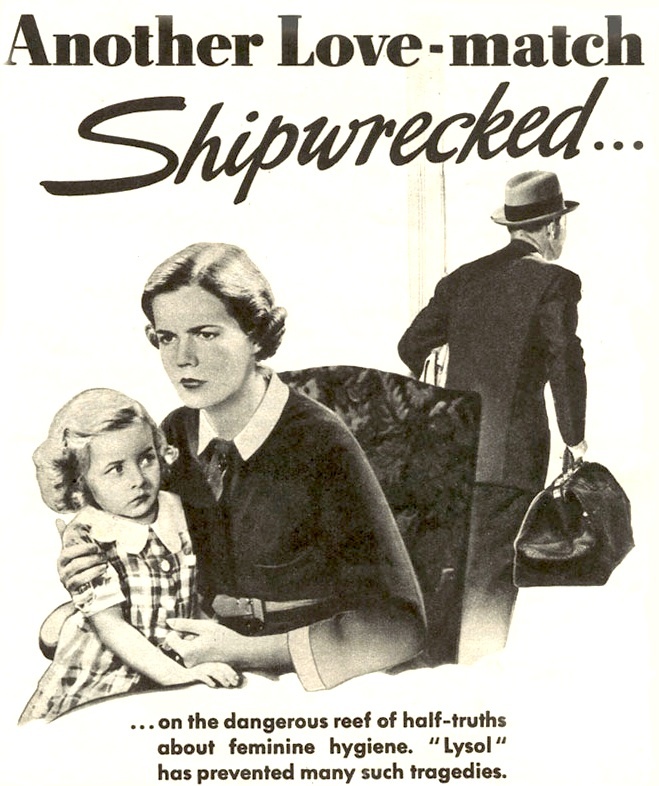
- Lysol disinfectant — which today is most often sold as a pre-mixed aerosol or pump spray — was introduced in 1889 as a liquid concentrate. A one-percent solution was often recommended as a method to reduce the occurrence of yeast infections and vaginal odors. But the original formula included cresols, and by 1911 the formula was changed after being linked to 193 poisonings and five deaths from douching.[note 10] Even after this change, many gynecologists warned against douching with Lysol because it killed the weak uterine bacteria that, in turn, killed stronger, infectious bacteria. Still, douching with Lysol was the most popular birth control method in the US between 1940 and 1960, when the pill was introduced.[28][note 11] (Many large retailers have stopped selling Lysol liquid concentrate in favor of their sprays. But you can still find it at the world's most ubiquitous big-box retailer.)
- A product known as Dr. Bronner's Soap, which is essentially a woo flavored douche based around altering the pH of the vagina, but this could be actively dangerous. Alternatively if the aim is to prevent implantation of the embryo into the womb, it may have to be continued for prolonged periods of time.[note 12]
- Herbal contraception — It's worth mentioning, more for historical interest than practical use. Various herbs, fruits, and vegetables, including pomegranate, neem oil, marijuana, and wild carrot seeds, are known to lower male or female fertility to some extent, and have been used for contraceptive purposes in the past, or in societies which do not have access to modern birth control products. However, their effectiveness is highly unreliable and does not compare favourably with modern contraceptive methods.[note 13]
- Radioactivity — In the Hunter Davies novel Here We Go 'Round the Mulberry Bush, it was suggested that the radiation from a luminous watch placed by the testes for several hours would kill any sperm, and thus prevent conception. However, modern luminous watches are no longer radioactive — and even if they were, hanging a lump of radioactive material around one's genitals would not be recommended.
- Morning After Prayer — It might be the single most used form of "birth control" for kids first playing around with sex. It usually involves lots of "oh my god [or gods], I promise I'll never do that again," and "please please please don't make me pregnant!" There are no studies to show how effective this is, but given that God routinely kills off 90% of fertilized eggs,[note 14] perhaps there is more to this method than we think. Probably not, however.
Male contraception[edit]
There is a growing body of studies that have produced potential long-term, but temporary male contraception. However, the largest stumbling block is the funding for something that does not have a strong market value. That is to say, men are not demanding it. Why? Cause by and large, statistically, men are fine with women taking control of this area, and self-reporting studies suggest that they resist the idea of "taking hormones into my body to control my reproduction."[29] In this case, what's good for the goose clearly is not good for the gander. Some conspiracy theorists (such as Mike Adams of NaturalNews) have decided that attempts to produce reversible forms of male contraceptives are in actuality attempts to develop chemical weapons intended to permanently sterilize ethnic minorities.[30]
Diversionary techniques[edit]
- Masturbation is giving oneself sexual pleasure by manual stimulation of one's own genitalia. Like abstinence, it is almost 100% effective in preventing pregnancy. Risks of blindness and hairy palms have been greatly exaggerated.[note 15] Masturbation is not exclusively a solo activity, and it is possible to stimulate another person's genitalia. When two or more people stimulate each other with this method, it is called "mutual masturbation".
- Oral sex is the simulation of the genitalia of another person (or, for the incredibly flexible, and lucky, oneself) using the lips, tongue, and, if they actually enjoy it, teeth. It is nearly 100% effective in preventing pregnancy; however, as with abstinence, passions can spin out of control, causing the couple to actually do the deed without a proper means of artificial contraception.
- Anal sex is the insertion of a penis or dildo into the anus. It is almost 100% effective, but there is a theoretical possibility (when the receptive partner is female)[note 16] that the sperm will migrate out of the woman's anus and into her vagina. Anal sex is riskier than vaginal sex because of the thinner, capillary-rich, walls of the anus, compared to the thick muscular walls of the vagina. This increases the likelihood of disease transmission when unprotected; in the case of HIV, the transmission rate goes up nearly 20-fold.[31] If you do engage in anal sex, make sure to wash/replace protection before engaging in vaginal sex to prevent possible infection of the vagina with rectal flora or fauna. Also note that unlike the vagina, the anus cannot produce its own lubrication: you must provide this yourself with appropriate products.
- Anal sex can be performed with a male condom to minimize the likelihood of disease transmission. Oral sex can use a male condom or dental dam (depending on the gender of the recipient) to prevent disease transmission.
Politics[edit]
Racism, white supremacy[edit]
Promotions of birth control alongside eugenics and tainted with overt white supremacy was common in the Progressive Era. Anti-Japanese racism in Oregon, for instance, partially gave way to the career of pro-KKK, birth control activist governor Walter M. Pierce, whose tenure oversaw eugenics employed to systemically oppress those deemed "unfit" or "inferior."[32]
Freedoms[edit]
Easy access to birth control has led to women being able to more directly and consistently participate in society, both intellectually and economically, and remains a critical aspect of gender equality and individual independence. As long as a woman is tied to her reproductive system's whims, she cannot be a fully participating member of society on her own terms. If she wishes to attend medical school, work 80 hours a week at a top law firm, become an EU astronaut, or simply make it through high school, controlling her own reproduction is critical. Plus, if she is tied down to children she cannot afford and does not want, society must usually step in to support her and the child — diminishing her ability to give back rather than take.
Economics[edit]
The Guttmacher Institute studied the effects of birth control on society and concluded that the benefit of providing free birth control to any woman or man who requests it far outweighs the costs involved, saying that: "Women's ability to obtain and effectively use contraceptives has a positive impact on their education and workforce participation, as well as on subsequent outcomes related to income, family stability, mental health and happiness, and the well-being of their children."[33] Families are smaller, and they tend to be delayed until the woman (and, if relevant, her partner) can support the children, women work at higher-paying jobs, and for longer periods, adding to the tax base, and are able to consume more, adding to the overall economic stability of a society.
Sexual politics[edit]
“”"Give a 17-year-old teen a condom and their thoughts turn immediately to sex."
"Sure, but give a 17-year-old teen anything and their thoughts turn immediately to sex." |
Birth control is not simply about a woman choosing when to have a child, but about the fact that she now can choose to have sex "with no repercussions."[note 17] She is no longer tied to one man and marriage. Her sexual choices become about her desire for sex, and her identity as a human being and not simply a way to procreate. While it has long been accepted that men have sex for sex's sake, that freedom has only been extended to women since access to birth control became commonplace.
Though less often recognized, safer sex also substantially increases the ability of married heterosexual folk to get some time in the sack. Given that married folk have sex 3-5x more often than unmarried folk, and married folk make up 40-60% of the population, the rampant increase of in-marriage sluttery may substantially outsize the rise of independent sluttery. Stand against married sluts — stand against the pill!
Abortion reduction[edit]
The only legitimate way to prevent abortions is to prevent unwanted pregnancies, something that could be easily done if medical birth control were free or very low cost, and easy to access.[36] In Colorado, birth control is free for teens and the teen pregnancy rate has dropped significantly. Naturally, fundamentalist Christians disapprove.[37] So, Rush Limbaugh, Great Fighter of the Feminazis: Do you want to reduce abortion or increase it?
Water pollution[edit]
The estrogens used in hormonal birth control wind up in the urine. They are difficult to remove from wastewater, so a lot of it winds up in the environment. Animals are quite sensitive to even small amounts of these hormones, and they have been shown to cause fish and frogs to develop intersex features. [38]
Obamacare[edit]
2012 was witness to an attack on birth control not seen since Griswold v. Connecticut. After discovering that birth control for women will be necessarily covered without copay in the new health care plan, conservative bishops began rumbling about religious freedom. The Catholic Church and the Freedom from Religion Foundation have joined in.[39] When Barack Obama declared that there would be no exemption for religious organizations that were employers (i.e., not actual houses of worships, but schools, hospitals, and care centers run by churches), the rumbling became an all-out call to arms, as the Religious Right and the Republican Presidential nominees turned women's bodies and what has been scientifically-accepted preventive medical care for women for 50 some odd years into a battleground. Obama sharply parried, saying "fine, you don't have to pay, but the insurances will be required to offer it for free to those women"[40] (which, by the way, the insurance companies actually love, because it is seven times cheaper to provide the most expensive birth control than pay for one easy pregnancy and labor).[40] The Religious Right still screamed about "religious freedom", even though the "compromise" removes them from any payment of the birth control. In fact, birth control and women's reproductive rights played a major factor in the entire 2012 election cycle at local, state, and of course, federal levels.
A rape victim alleges she was denied emergency contraception because supplying the morning after pill went against a jail employee's conscience. She is suing for gender discrimination, violation of privacy, and denial of equal protection.[41]
Of course, almost none of the politicians or priests are doctors, let alone gynecologists. The arguments against mandatory provisions for inexpensive or free birth control completely ignore the fact that many birth control medicines are used for other medical purposes, such as controlling acne, reducing physical distress during menstruation, controlling excessive bleeding, and managing the symptoms of endomitriosis and fibroids.
Religious opposition to contraception[edit]
Like all things in religion, objections to contraception tend to follow the level of social liberalism in any given religion, and therefore tend to vary from temple to temple, church to church.
Judaism[edit]
Based in no small measure on a mistaken understanding of human biology at the time the Torah and other Jewish writings were being codified, Jewish law prohibits any method of contraception that prevents the sperm from reaching the "womb", in other words, barrier methods of birth control. However, Jewish law does not prohibit the pill (or other hormone forms) nor an IUD device.[42] Technically, the prohibition on barrier birth control is the same as the ban on masturbation, so if you were ok with rubbing one out, then you can rubber one in. The ultra-orthodox, of course, prohibit all forms of birth control unless the mother's life would be harmed by a pregnancy. Judaism actually requires a reverse of the rhythm method, as women are required to be abstinent during and the week following the period,[43] although not everyone strictly adheres to every rule.
Christianity[edit]
The Roman Catholic Church is renowned for its opposition to artificial contraception, even in cases where there are serious health concerns, such as the AIDS epidemics in Africa, as well as generic STDs risks of any sexual encounter.
The majority of Protestant denominations have no problem with non-abortifacient contraception. However, a few fundamentalist groups such as the Quiverfull movement maintain that God should be the only judge of when conception happens, and that a large family helps bring more Christians into the world; they are thus not big fans of contraception.
Condoms and the Catholic Church[edit]
“”
Dad: Come in, my little loves. I've got no option but to sell you all for scientific experiments |
| —Monty Python's The Meaning of Life[44] |
Traditionally, the Roman Catholic Church has always maintained that God thinks that condoms are a bad idea[45] — which is probably best summed up by Monty Python's Every Sperm is Sacred. This has always been the case, and Pope Benedict XVI, a fairly staunch traditionalist, received a lot of flak during his papacy for enforcing the effective ban; particularly his comments around condoms and AIDS. For instance, during his trip to Africa in March 2009, he claimed that condoms could make the African AIDS crisis worse.[46] This position is maintained online to this very day.[47]
However, in November 2010 the Pope nuanced God's position somewhat when he made some slightly confusing statements on the matter. God's opposition to condoms for contraceptive purposes was said to remain as strict as before, while at the same time the Pope back-pedalled slightly on whether they could be used to prevent the spread of AIDS. His example of allowed use at first appeared to be for male and/or gay prostitutes, but this was later clarified (they, of all people, should know the hassle that can arise from translation problems) to also include women equally.[48]
Islam[edit]
Understanding that all Islamic legal views of sexuality are considered within the context of marriage, as sex outside of marriage is haraam (forbidden), eight of the nine classical schools of Islam allow contraception use by the couple throughout the last millennium.[49] However, there is a growing trend of imams campaigning against contraception.[50] This is especially true in poverty-stricken areas of North Africa, where "anti-Western" ideologies commonly influence religious proscriptions. Mainstream Islam has countered (in three major international conferences over the last 10 years) to remind people of the importance of population control, as well as individual health concerns for both women having too many children, and families who have to struggle to feed and care for the children.[51][52]
Buddhism[edit]
Buddhists claim that any contraception that prevents a fertilized egg from developing is unacceptable. They only allow barrier methods or spermicides. In reality, however, since most of what modern hormonal birth control does is preventing conception, it is generally accepted, especially in modern Buddhist societies in the West, Japan, and urban areas of the Far East.[53]
See also[edit]

|
For those of you in the mood, RationalWiki has a fun article about Birth control. |
|
|
For those of you in the mood, RationalWiki has a fun article about Condom. |
External links[edit]
Notes[edit]
- ↑ Contraception, by definition, is a chemical, hormonal, or physical prevention of conception. Chemical and barriers keep sperm from reaching eggs, and hormonal prevents eggs from being released.
- ↑ Singular: vas deferens
- ↑ The National Review is probably the oldest of Cold War wingnut politics, and even they have been adamant that this is insane.[7]
- ↑ Sadly, the single most common reason for unwanted pregnancies, according to the CDC, is not taking the pill as prescribed. Called in non-medical circles "Oops, I forgot."[9]
- ↑ "Less than one woman in 1,000 will get pregnant in one year."[11]
- ↑ The effectiveness rate is more difficult to calculate, since not all acts of sexual activity will result in a pregnancy, and these are "one off" pills.
- ↑ Well, the "weird cases" of men getting pregnant are actually transexuals.
- ↑ And if you did, she's either a very lucky woman, or about to be in a lot of pain.
- ↑ See Monty Python's Every Sperm is Sacred for a detailed and historically-accurate discussion of the Catholic view.
- ↑ Not to mention many suicides and homicides from poisoning.
- ↑ The term "feminine hygiene" in this advertisement is allegedly a euphemistic reference to Lysol's use for birth control at a time when the promotion and use of non-prophylactic birth control methods was illegal in much of the United States.
- ↑ Perhaps in terms of several 24-hour days, continuously.
- ↑ See Herbal Contraception for more information, but please don't consider this as a serious contraceptive option.
- ↑ Cheeky, but true. Studies show that less than 10% of fertilized eggs will implant in the uterus.
- ↑ Please be sure to dispose of your batteries in an environmentally-friendly manner.
- ↑ If you don't know why this qualification is necessary, read Myra Breckinridge, or just see Wikipedia's article on pegging. ("I don't want to hurt you; I only want to teach you…")
- ↑ One need only read the fundie talking points[34] around free contraception[35] to see this view parroted often.
References[edit]
- ↑ See Johnston, Levi.
- ↑ Abstinence and abstinence-only education, Mary A. Ott and John S. Santelli, Curr Opin Obstet Gynecol. 2007 Oct; 19(5): 446–452. doi: 10.1097/GCO.0b013e3282efdc0b
- ↑ Abstinence-Only Education Is Ineffective And Unethical, Report Argues, NPR, Aug 23, 2017
- ↑ Abortion rate United Nations Statistics Division.
- ↑ Russian Birth Control options
- ↑ More U.S. Women Getting Birth Control Services by Kathleen Doheny (Aug. 13, 2008, at 4:00 p.m.) U.S. News & World Report.
- ↑ Pharmacists Can't Be Allowed to Deny Women Emergency Contraception: All women should have access to EC without delay or being judged or shamed by their healthcare provider. by Gretchen Borchelt (Oct. 15, 2012, at 8:00 a.m.) U.S. News & World Report.
- ↑ John Rock's Error
- ↑ Birth Control Pills American Pregnancy Association.
- ↑ Birth Control Planned Parenthood.
- ↑ Contraceptive implant — Your contraception guide (Page last reviewed: 22 January 2018) National Health Service.
- ↑ House Wiki
- ↑ See the Wikipedia article on Emergency contraception.
- ↑ Planned Parenthood on emergency contraception.
- ↑ How many birth control pills can be taken after unprotected sex for emergency contraception? Go Ask Alice!
- ↑ New Warning: Morning-After Pill Doesn’t Work for Women Over 176 Pounds by Molly Redden (November 25, 2013) Mother Jones.
- ↑ Lemons, Sponges, and Other Old Forms of Birth Control: Pope Francis suggested that women in Zika-infected areas could turn to the age-old practice of birth control. by Becky Little (February 19, 2016) National Geographic.
- ↑ Gay Life — condom brands
- ↑ Safety First: 14 Common Condom Use Errors by Stephanie Pappas (February 24, 2012) Live Science.
- ↑ Do condoms work? by William Pett (February 2019) aidsmap.
- ↑ American Pregnancy Association
- ↑ [www.forbes.com/sites/alicebroster/2020/07/15/how-does-sex-change-your-vaginas-ph/ How sex changes your vagina, Forbes]
- ↑ [www.healthline.com/health/womens-health/vaginal-ph-balance Vaginal pH balance, Healthline]
- ↑ [www.medicalnewstoday.com/articles/322537 Vaginal pH balance: Symptoms, remedies, and tests, Medical News Today]
- ↑ Modern Rhythm by Sarah Yang (Jan. 1, 2001) WebMD via MedicineNet.
- ↑ [www.verywellfamily.com/does-female-orgasm-boost-your-odds-of-getting-pregnant-1960265 Female orgasm and the chance of pregnancy]
- ↑ What is a douche?
- ↑ When Women Used Lysol as Birth Control, Mother Jones
- ↑ Male birth control pill soon a reality: Implants, patches and creams also on the way by John Schieszer (2011) MSNBC (archived from May 13, 2011).
- ↑ Bill Gates funds technology to destroy your sperm by Ethan A. Huff (February 01, 2012) Natural News (archived from February 1, 2012). Try to make sense of this. We dare you.]
- ↑ CDC estimated transmission risk of HIV
- ↑ The Paradox of Oregon's Progressive Politics, pp. 407-09.
- ↑ Introduction of Guttmacher Institute's study
- ↑ Attendees At Conference Say Contraception Promotes Promiscuity, Harms Relationships, Devalues Children (28 Sep 2006 — 6:00 PDT) Medical News Today (archived from 23 Jul 2013 21:25:53 UTC).
- ↑ Rush Limbaugh calls law student a ‘slut’ for wanting contraception to be covered by health insurance at religious institutions by Lindsay Goldwert (Mar 02, 2012 | 1:33 PM) New York Daily News.
- ↑ Study: Free birth control leads to way fewer abortions (October 5, 2012 / 1:51 AM) AP via CBS News.
- ↑ Colorado birth control scheme causes drop in teen pregnancy
- ↑ Water Pollution Caused by Birth Control Poses Dilemma by Wynne Parry (May 23, 2012) Live Science.
- ↑ FFRF ad, ‘Quit the Catholic Church,’ runs in today’s Times
- ↑ 40.0 40.1 Obama Birth Control Compromise Defuses Religion Issue: Only in our absurd health-care system is a woman’s boss involved with her sex life. by Dana Goldstein (Updated Jul. 13, 2017 11:24AM ET; Published Feb. 10, 2012 3:55PM ET) Daily Beast.
- ↑ Rape Victim Can Sue for Denied Contraception
- ↑ Judaism and contraception (Last updated 2009-07-21) BBC.
- ↑ What is the mikveh, Jewish Women's Archive
- ↑ The Meaning of Life Script. The Miracle of Birth: Part 2: The Third World Another Bleedin' Monty Python Website.
- ↑ Vatican website on condoms
- ↑ The Guardian -Pope claims condoms could make African Aids crisis worse
- ↑ Vatican website on condoms and HIV/AIDS prevention
- ↑ The Guardian — Pope's condom comments apply to women too, says Vatican
- ↑ Islamic views on contraception (Last updated 2009-09-07) BBC.
- ↑ Islam, Women and Family Planning: A Primer (December 1, 2001) Guttmacher Institute.
- ↑ Family planning United Nations Population Fund.
- ↑ Family planning, Contraception and Abortion in Islam: Undertaking Khilafah: Moral Agency, Justice and Compassion by Sa'diyya Shaikh (2003) In: Sacred Choices: The Case for Contraception and Abortion in World Religions, edited by D. Maguire. Oxford University Press. ISBN 0195160002.
- ↑ Buddhism and contraception