Nazism
.svg)
| A lunatic Chaplin imitator and his greatest fans Nazism |

|
| First as tragedy |
| Then as farce |
| Suppress the dissenters Fascism |

|
| Bundle of rods |
| Fascists |
| Groups |
“”The craziest of all political systems, the unique dictatorship, found its earned end. History will note for eternity that the German people were not able on their own initiative to shake off the yoke of the National Socialists. The victory of the Americans, English and Russians was a necessary occurrence to disrupt the National Socialists' delusions and plans for world domination.
|
—Friedrich Kellner, My Opposition, diary entry for May 1, 1945 My Opposition, diary entry for May 1, 1945
|
Nazism (the common English-language short form of the less-commonly used full official name National Socialism) is a term referring to the political beliefs held by the Nazi Party (officially the "National Socialist German Workers' Party" — Nationalsozialistische Deutsche Arbeiterpartei, commonly shortened to NSDAP) a party and ideology of German politics from after World War I (1914-1918) until the end of World War II in 1945. Nazism was a form of fascism and resembled contemporary Italian fascism in many particular ways, such as totalitarianism and ethnic nationalism, although it emphasized race much more strongly. The Nazi Party destroyed terrorized ruled Germany from 1933 to 1945, during a period known as the "Third Reich". (If you were wondering, the Holy Roman Empire ranks as the first Reich, and the second Reich was the German Empire of 1871-1918. Despite lasting longer than Hitler's "thousand-year Reich", the Weimar Republic — officially known as the "German Reich" — doesn't count in Nazi arithmetic.)
In the 1920s and 1930s, communists lumped all their authoritarian enemies together under the label of "fascist". Today, many people use the terms Nazi and fascist (or fash) interchangeably, continuing this usage. Since very few actual Nazis remain alive (although there are many neo-Nazi individuals and groups today), the term often more generally refers to various authoritarians, especially those who focus on hate, racism, or grammar, though brandishing the word "Nazi" around in a haphazard fashion when referring to anyone who disagrees with you somewhat diminishes the atrocities committed by the Nazi regime.
Communists, and other socialists, have also encouraged the use of the term "Nazism" over "National Socialism" for obvious reasons — they don't wish to be conflated with it or tainted by the "socialism" part of the "national socialism" moniker. "Nazi" is still technically a nickname — though the NSDAP never used the term. Stalin's Soviet Union (1924 to 1953) preferred terms such as "Hitlerite" and "Hitlerism" over "National Socialism".
Origins[edit]

The myriad of influences leading up to the rise to power of the Nazis are well documented, but many of the Nazis objective beliefs are hotly debated. Oswald Spengler's historical determinist book The Decline of the West is cited as an "intellectual" influence. However, his work was later banned by the Nazis because he dared to criticize them and rejected antisemitism. Spengler also rejected racism and found racial superiority laughable since the work the Nazis loved had eight dominant cultures (called 'high cultures'), only two of which were European.[note 1] Ironically, his other book, Prussiandom and Socialism, provided a basis for their view of socialism. Germanic romanticism and national mysticism, as expressed in Wagner's operas, the Wandervögel youth movement (which was outlawed by the Nazis, too), and German occultist movements like Ariosophy and the Thule Society are also cited as precursors. The Thule Society also took influence from Theosophy and Helena Blavatsky's theory of "Root Races". More hotly disputed is the extent to which Nietzsche may have been an influence, but his sister Elisabeth was an early and enthusiastic supporter of Hitler and helped the Nazis to claim him as one, at least in name; some allege that certain potentially racist turns of phrase found in current editions of his works (most famously, the "splendid blond beast of noble race") were added by her after his death.
A more apparent immediate precursor was the state of Germany after World War I, when the country experienced hyperinflation and economic collapse during the Weimar Republic period and suffered under the international sanctions imposed after the war, and many Germans were confused about the outcome of the war. Wartime censorship led many to believe that the German Army was undefeated in WW1 until the day they surrendered, seemingly out of the blue. Germany and Austria lost large amounts of territory, particularly in Eastern Europe and Saarland and Alsace. Some areas had pockets of ethnic Germans and German speakers, and these areas' (re)conquest was seen as a priority.
As well as philosophical and mystical influences, Nazism had diverse political roots. The most obvious would include Prussian militarism and pre-existing German ultranationalism. It also was influenced by Mussolini's original fascist movement (which coalesced earlier) and Marxism-Leninism (directly opposing it but copying certain elements such as its military cadres, youth movements, and red flag). Despite its mystical roots, National Socialism also had a technocratic element and saw new technology as a means to subdue its foreign enemies.
The predecessor to the NSDAP, a tiny group of a few dozen individuals calling themselves the "German Workers' Party", was founded in 1919 by an unimaginative nobody called Anton Drexler. Hitler, at that time a military man, was given the task of spying on this group but decided to take it over instead. Because of Hitler's charisma and the talent of many of his followers, the Nazis were able to mostly absorb the other right-wing movements in Germany at the time, and with the help of Ernst Röhm, were able to mobilize them as a brutal street fighting force all throughout Germany, significantly hindering any democratic processes. The Nazis would find significant electoral success starting in 1930 and become the largest party in the Reichstag in 1932. While the Nazis did use violence and intimidation to stack the deck in their favor in these two elections, it is essential to remember that much of their support was legitimate, despite post-war hand-wringing. Less than a year later, Hitler was named chancellor after the Reichstag fire and quickly consolidated power before abandoning the pretext of democracy entirely. The Nazis came to power promising to restore Germany's "might" after this period of national pessimism and effectively manipulated the recent popularity of Germanic romanticism to his advantage. They also offered an explanation for Germany's failure in WW1, adopting the position that the Germans would have won the war if not stabbed in the back by Communists and Jews (these two were often merged into one boogeyman Hitler termed Judeo-Bolshevism). This proved irresistible to some segments of society who were quick to fall for demagoguery blaming "the Jews" and other sinister forces for Germany's plight. The NSDAP's brand of "national socialism" was seen by conservatives and business elites as a favorable alternative to Bolshevik communism, which they feared might overtake Germany, as it had a strong following among the German working class. The influence of socialism within the NSDAP is also hotly debated; there was a faction within the party, the Strasserites, that took the "socialism" part of National Socialism seriously, but they were violently purged (with a few exceptions) from the party soon after Hitler consolidated his power.
Support outside Germany[edit]
Nazism also gained some popularity outside Germany, most obviously in Austria. Ethnic Germans in other countries were persecuted after WW1 and were blamed for causing it. In some countries, non-Germans also became sympathetic to the movement. Some non-German nationalists from Ukraine, Lithuania, Croatia, and Brittany collaborated with the Germans to fight their cause. Franco was willing to use the Third Reich forces to win the Spanish Civil War, although he wisely avoided joining WW2. In Austria, involvement with Nazism was more complex — although Hitler was Austrian and Austrians became full citizens, the Anschluss or Union between the two countries took place under pressure.
Further afield, Nazism found some support among the Afrikaner population, Hindu nationalists, German-Americans, and ethnic Germans in South America. While few Afrikaners fought for Hitler, Nazism influenced the system of apartheid and white supremacism in South Africa.
Since World War II, forms of National Socialism, usually based on the German model, have taken root elsewhere, including countries that fought against Hitler — such as the United Kingdom, Norway, and Russia. One of Russia's manifestations, the National Bolsheviks, combines Nazism with some of the ideas of Lenin.
Gay Nazis?[edit]
On the other hand, the claim of certain Religious Right wingnuts like Scott Lively and Soviet propaganda author Maxim Gorky that Nazism emerged out of a homosexual subculture is almost universally discredited, except among homophobes. It's true that Ernst Röhm was homosexual, as were numerous other leaders of the Sturmableitung (SA); privately, Hitler had promised Röhm that homosexuals were to be protected despite Hitler's public rhetoric against homosexuality. It's also true that a large number of the rank-and-file of the SA were homosexual. Why? Because homosexuals of the era were inherently social outcasts, and outcasts are always the ones most likely to join any fringe group that offers them a purpose and place in society. The causal link ends there; Röhm's sexuality was a liability in the public eye, and many of the early Nazi leaders were effectively rivals to Hitler himself, so the SA were butchered in an event known as Night of the Long Knives. Röhm had outlived his usefulness, and the SS which replaced the SA most definitely did not have openly homosexual members allowed in.
If anything the real lessons that should be learned from homosexuals within the Nazi Party are that 1) turning swaths of otherwise healthy and productive members of society into outcasts is what enables extremist ideologies to rapidly grow, and 2) just because you supported the violent fringe group from the start does NOT mean they won't send you to the executioner's block the moment they no longer need you.
End-Goal[edit]
National Socialism's ideological incoherence fueled its virulence. There was no end goal of conquest or purity: it focused purely on the twin processes of struggle and racial strengthening/cleansing. There could be no peace, no acceptable measure of racial purity, and no absence of enemies. Nazism was not, in this sense, Utopian "because in a Utopia there are no enemies". Ultimately, every measure short of near-omnicide was a mere tactical concession. The Nazis did not militarise their society and wage wars of conquest because they feared weakness: they did it to be militaristic and conquer.[1]
Legacy[edit]
The legacies of Nazism are many and complex. The flagrant way in which this complex legacy is often reduced and simplified to score a cheap point has led to the necessity of Godwin's Law:
As an online discussion grows longer, the probability of a comparison involving Nazis or Hitler approaches one.
The German Nazi Party and its subsidiary organizations were quickly dissolved under Allied occupation and were illegal in the German Federal Republic, the German Democratic Republic, and Austria. With the reunification of Germany, the ban on Nazi activities, symbols, and songs remains intact.
In terms of tangible things, it's telling that the Germany left behind by the Nazis had many of its cities reduced to smoldering rubble, its industry and infrastructure systematically crushed, a large portion of its population annihilated, and its land split apart and occupied by foreign forces, with the explicit goal of preventing Germany from rising again for the foreseeable future. Food shortages were common in the early post-war period, and Germany depended entirely on foreign help to recover. The Nazis, in other words, left behind a legacy of little more than the death and destruction of the people they sought to elevate. Their thousand-year Reich was destroyed in a scant 12 years.
Nazis and occult craziness[edit]
The Nazis were also proponents of Horbiger's Cosmic Ice theory, which held that the stars were made of ice. They also imagined they had superior intelligence, which seems a bit at odds with the previous sentence.
They contended that the novel Spring in Atlantis (Frühling in Atlantis)[2] by Edmund Kiß (or Edmund Kiss) was based on truth — that the Aryan race was descended from Atlanteans (or if they did not originate in Atlantis, then it had to be something similar and northern called Thule), which was later overrun by inferior races.[3] The Waffen-SS (the paramilitary wing of the NSDAP) employed a team of archaeologists searching for proof of these theories, similar to that featured in the Indiana Jones films.
On a political spectrum[edit]

“”People who say "Hitler was a socialist cuz his party included the word socialist" must be incredibly confused that the titmouse is a bird.
|
| —@TheNewMeat[4] |
Nazism is more complicated than fascism when trying to place it on a political spectrum. The majority of scholars identify Nazism, in practice, as a bizarre form of right-wing extremism.[5] Many Nazis were advocates of third-positionism when it came to economics. This meant that they opposed both socialism (especially communism) and capitalism, despite many being advocates of the right to own private property (so long as you were an Aryan... but that goes without saying). They differ from capitalists (in economics) because they openly advocated a symbiosis between the state and big business. The state would favor certain companies (German-owned, of course) in return for them doing favors to the state. Basically, the Nazis openly endorsed crony corporatism. Up until relatively recently, this economic nationalism was shunned by mainstream conservatives. However, since the rise of ultra-conservatism and right-wing populism in the West, these third-position policies have quickly become the ethos of right-wing economic practices. For instance, Steve Bannon and the alt-lite's intellectual wing have expressed explicit third-position economic policies. While not an economic isolationist like Bannon, Donald Trump follows a model very similar to (but much, much older than) economic nationalism — the precursor to capitalism, corporatism, and socialism: a crony 17th-century system known as mercantilism. Even populists on the economic "left" support economic nationalism, as many right-wing counterparts do. While they are both protectionists, the only difference between the pure economic isolationism of the third position and the mercantilism of the right is that the former is obligatory, and the latter is coercive via tariffs. However, they both encourage state intervention when setting market prices.
One might also note that Nazis expanded universal healthcare programs, but the goal was never about improving the life of the general public, but of a combination of Eugenics and conquest,[6] in much the same manner that a country might provide healthcare for its military. Some versions of socialism (especially Democratic Socialism) do in fact come in the form of generous social safety nets instead of direct worker ownership, but the very definition of socialism is that everyone (or at least the working classes) does "own" the industries; if the industry relies upon slavery or ethnic underclasses who have no say, it's by definition not socialism. In the sense that there were social safety nets, they existed only for Aryans alone, to be subsidized by the ethnic underclasses. Note that public healthcare in Germany was already in existence for 40 years prior to the Nazi takeover, regardless of what the GOP might say about Obamacare.
Notable Americans try to push Nazism to the other side of the political spectrum or deny that Nazism was truly right-wing. While it's evident that Nazism is entirely different from the politics of their own party's establishment (in that Nazism is much further to the right with its advocacy of antisemitism, genocide, misogyny, etc.), that does not automatically discount their right-wing elements. However, its odd form of right-wing politics is removed from today's mainstream conservatism (neoconservatism should tell you that quite blatantly). Many on the right refuse to accept this, as they are unable to comprehend two basic notions: that "right and left" are both simplistic and arbitrary concepts depending on the context of the time and place (for instance, laissez-faire capitalism, which is now generally seen as being right of center, was once as radical in 1790 as socialism is seen today); that both wings incorporate countless individual schools of thought, and are not indicative of singular and universal ideologies. Partisanship is an entirely separate issue, as, though it is not as common anymore due to polarization, there can exist left-leaning Republicans (though that is generally no longer the case) and right-wing Democrats (such as the Clintons and Jimmy Carter... not to mention that the political spectrum, which was once a contextually simple concept, has been made more complicated than it even should have been in the first place. The most extreme ideology of right-wing thought is, by definition, monarchism, to which mainline fascism like that of Italy in the 1920s and 30s was very similar.
The Nazis were much more obsessed with race than their Italian counterparts. As it is understood today, the idea of race did not come about until globalization began before the Age of Enlightenment. The Nazis were generally not anti-religion (although a few Nazi leaders were quite so, notably Goebbels and Rosenberg, and even Hitler occasionally criticized Christianity in private); rather, they were very anti-church. They didn't like other powerful organizations exerting control over their subjects and monitored the clergy closely to spot even the slightest evidence of disloyalty. They also did not like religious groups with values that strongly conflicted with their own — for instance, the Jehovah's Witnesses were ruthlessly oppressed by the Nazi regime because they opposed military service and loyalty oaths. It is very similar to the modern alt-right phenomenon: socially far-right (for the same reasons as the OG Nazis) and organizationally collectivistic. They are generally considered a constituency of the American right due to their history of association with the GOP and, more recently, paleoconservative and populist movements, Donald Trump being a great example of the latter (although Trump seems to hold views more in line with monarchism than Nazism, which, in some ways, is even worse). "Alt-right" is a term originally coined by the Nazi cosplayer Richard Spencer to describe an ideology that was an alternative to traditional right-wing thought, particularly conservative, hence "alternative to the right", as he put it.
So economically and socially — Nazism gives you the worst of both worlds. It's almost like the system was a contradictory, incoherent mess cobbled together based on the increasingly insane and drug-addled rantings of a failed artist.
In any case, Nazism was primarily concerned with Aryan racial purity and territorial conquests; racism and imperialism were its defining features. Like most imperialist regimes, conquests were made to benefit the imperialist power's population; in this case, the German volk. Lebensraum existed for fear that Germany was on the brink of starvation and needed resources. German motives for invading Poland, Russia, etc., were equally racist and imperialist. The need for Germany to expand was commonly defended by Germans with the belief that Slavs and Jews were destined to be serfs for Aryans, and the extermination of Slavs and Jews was defended by Germany's perceived need for land and resources.[7] It cannot be stressed enough that this type of thinking was frighteningly common among other Western powers. Only their aggressive pursuit of war and genocide made them unique. Regarding economic policy, the Nazis were unremarkable and very much inside the mainstream. Therefore, if someone does not aggressively support war and genocide, no matter what side of the political spectrum they're on, they shouldn't be compared to the Nazis.
Religion in Nazism[edit]

The role of religion in the ideology of the NSDAP has been a much-discussed and controversial question. Hitler distinguished between "master religions" and "slave religions." According to Hitler, master religions would help the Aryan master race dominate other races. Religions that preached love and tolerance would hinder the master race from dominating others:
Hitler extended his rationalizations into religious doctrine, claiming that those who agreed with and taught his 'truths' were 'true' or 'master' religions because they would 'create mastery' by avoiding comforting lies. Those that preach love and tolerance, 'in contravention of the facts,' were said to be 'slave' or 'false' religions. The man who recognizes these 'truths,' Hitler continued, was said to be a 'natural leader,' and those who deny it was said to be 'natural slaves.' 'Slaves,' especially intelligent ones, he claimed were always attempting to hinder masters by promoting false religious and political doctrines.[8]
Basically, people either had to agree with the Nazi-type religion or be treated as slaves, and so-called slave religions were persecuted.[9]
The claim by some that Nazism is an atheist ideology can be rejected out of hand. Nazism includes many near-mystical elements drawn from several different types of religion. The early Nazi party was also involved in several direct conflicts with freethinker groups in Germany as early as the 1920s. This hostility continued after Hitler took power in 1933 when atheist movements were banned in Germany; however, it is worth mentioning that at least a few members were atheists, namely Martin Bormann, who was openly anti-Christian,[10][11] and some others were probably religious, such as Heinrich Himmler (though he was more into German and Nordic paganism and wanted to revive it as a replacement for Christianity).[12] It is essential to note that Nazism is an ideology and thus will attract people from many different backgrounds. Generally, however, it opposed atheism, with atheists being banned in the SS (and denounced by its oath), mainly since atheism was a part of communist (the Nazis' arch-enemies) philosophy. Hitler, while reportedly attacking Christianity privately, also expressed a belief in God at the same time (while criticizing atheism), albeit possibly of a more deist or pantheist variety.
On the other hand, the opposing view that Nazism is based on Christianity is not credible, although this is a much more complex issue. Elements and themes drawn from Christianity often figured prominently in Nazi propaganda. Still, these were invariably twisted to fit the National Socialist context, possibly because Christianity was a prime element of Germany's cultural ethos.[13] Overall, it is probably better to see Christianity as carrying out a legitimizing function for Nazism rather than as a part of its ideological foundations. Eventually, however, a specifically National Socialist brand of Christianity evolved, known as Positive Christianity, which was basically quasi-pagan state worship based upon the notion that Jesus was an Aryan crusader who hated Jews and preached white supremacy in the name of an antisemitic god that frolicked around in the sky on his horse accompanied by his entourage of Wild Hunt ghost riders for no particular reason other than shits and giggles.
From a political perspective, it would also be outright wrong to categorize Nazism as a movement based on pushing Christian viewpoints due to the German Centre Party's popularity with the German Christians. If Hitler had been eager to push a Christian agenda, an alliance with the German Centre party would have occurred. On the other hand, it is undeniable that the CDU/CSU (a successor to the German Centre party) had a fair share of success thanks to the fact that former Nazis were in their ranks which successfully attracted other Nazis to vote for them.
On a more practical level, the Nazi ascension to power in 1933 resulted in the unification of the Protestant regional churches in each of the 28 federal states into one church known as the Deutsche Evangelische Kirche (German Evangelical Church). This new church was, from the beginning, dominated by the strongly pro-Nazi Deutsche Christen ("German Christian") movement, whose leader, the theologian Ludwig Müller, was also appointed as the first Reichsbishof. However, intense political and theological conflicts inside the church and waning interest from the Nazi leadership prevented the DEK from assuming any prominent role in the Third Reich. It had faded from significance by 1935. Many smaller Protestant churches remained outside the Deutsche Evangelische Kirche. In 1934, many of these joined together in the Bekennende Kirche (Confessing Church) movement, which aimed primarily at opposing the influence of the Deutsche Christen. Although many of its members were against the churches' unification for theological or confessional reasons rather than anti-Nazi, the Bekennende Kirche was seen as an opposition group by the Nazi government and was eventually persecuted, especially after 1937.

Some Roman Catholic Church clergy attempted (ineffectively) to oppose the Nazi regime.[14] Other clergy, the "Brown Priests" or Braune Pfarrer, were Party members.[15] Members of parliament from the Catholic Center Party voted for the crucial 1933 Enabling Act that gave Hitler dictatorial powers after Hitler gave a speech praising the role of religion in the German state. Despite all this, some people seem dead-set on convincing themselves that the Catholic Church or Pope Pius XII were somehow complicit in the Nazi crimes.[16][17] However, Pius XII was likely made aware of the ongoing genocide of Poles and Jews in Poland in December 1942 by Father Lother Koenig, a member of the anti-Nazi resistance.[18] Consequently, historian David I Kertzer has argued that Pius XII was a failure as a moral leader.[19][20]
Hitler seems to have used a mixture of beliefs to justify Nazi ideology, depending on what suited him at the time. This mixture included more or less conventional Christianity, borrowings from Nordic mythology, pseudoscience, and a belief in Germany's and his personal spiritual predestination for greatness. While he was disdainful of religion in his private life, he made substantial efforts to accommodate Christian beliefs to reconcile the German establishment to Nazism. Indeed, he referred to himself publicly as a Christian. Yet, he didn't care about theology personally — he was mainly interested in fulfilling his ordained role in history as Führer.
According to Albert Speer, Hitler privately stated, "[t]he Mohammedan religion too would have been much more compatible to us than Christianity. Why did it have to be Christianity with its meekness and flabbiness?’"[21] In the book Hitler's Table Talk, he also called the religion Bolshevism's "illegitimate child".[22] This could be possible due to the rise in Islamism and Wahabbism during the time, which were the product of anti-intellectual reactionary thought that grew out of the Ottoman Empire's collapse and the fundamentalism that, by then, had already established itself as the primary foundation of Saudi-Arabian society. The Goebbels Diaries by Joseph Goebbels also mentioned that:
The Führer is deeply religious, though completely anti-Christian. He views Christianity as a symptom of decay. Rightly so. It is a branch of the Jewish race. This can be seen in the similarity of their religious rites. Both (Judaism and Christianity) have no point of contact to the animal element, and thus, in the end they will be destroyed. The Führer is a convinced vegetarian on principle.[23]
Goebbels also despised Christianity and advocated for National Socialism as its replacement:
National Socialism is a religion. All we lack is a religious genius capable of uprooting outmoded religious practices and putting new ones in their place. We lack traditions and ritual. One day soon National Socialism will be the religion of all Germans. My Party is my church,… That is my gospel.[24]
The Nazis planned to replace Christianity and traditional church institutions with the National Reich Church. This religious organization would throw all things Christian out the window (Bibles, priests, chaplains, religious orders, etc.) in favor of a Nazi-based faith, as detailed in the "30 Points Program". There was also the German Faith Movement, another religious organization set up by the Nazis that would replace Christianity in favor of a religion that would fall more in line with Nazism mixed with ancient Germanic paganism.
Interestingly, Heinrich Himmler, the SS Reichsführer, thought Islam was compatible with Nazi ideology. He stated, "It's a religion that promotes the warrior and the war — and it promises sex in the afterlife."[25] Many Bosnian Muslims, Arabs, Africans, Iranians, and Indians joined the SS and fought for the Germans throughout the war. However, it is worth mentioning that many of these people joined more because Nazi Germany opposed their enemies (the British Empire for most, although in some cases, opposition to the USSR or Yugoslavia was the primary motivation) than any particular fondness for Nazi ideology. However, this did not mean that they were saints or above the brutality inherent to Nazism, especially given the heavy indoctrination the SS underwent.[25]
On the other hand, many Bosnian Muslims helped Jews during the war. The Albanian Muslims were so good at hiding Jews that no single Albanian Jew was killed in the Holocaust. Only one other country could keep all of its Jews from the Nazis: Bulgaria. It is very likely, however, that most Muslims weren't that much influenced by Hitler's existence because the division between Arab socialists and Islamists left little room for Nazi ideology to develop, as there was only one party that took direct influence from Nazi ideology in the Islamic World: the Syrian Social Nationalist party, which was unsurprisingly created by a Greek Orthodox Christian.
Hinduism also played a role in shaping Nazi thought. Not only was the swastika symbol taken from Hindu mythology, but Hitler believed in the Hindu notion of the Aryan race and wanted to create a caste system within Germany. There have been Nazi officers known for reading the Bhagavad Gita.[26] In turn, some Indians tried to synthesize Nazism with Hinduism. Think of all the moments Bal Thackeray celebrated Adolf Hitler as a hero.
To a lesser degree, Buddhism is also seen as an influence of Nazism. Many Buddhist scriptures were searched by the Nazis to continue the notion of a warrior religion.
Allegations of US and church cooperation[edit]
It has been suggested that the Catholic Church helped members of the Nazis escape after World War II with the assistance of intelligence agencies.[27]
Nazism in the United States[edit]

In 1936, the German American Bund[28] (also known as Deutsche amerikanische Bund or, as it called itself, Amerikadeutscher Volksbund) was founded after the dissolution of a smaller pro-Nazi group, Friends of New Germany (which itself was founded by the merger of two even smaller groups, "Gau-Nord Amerika" and the "National Socialist Teutonia Club"). Led by German-born Fritz Julius Kuhn,[29] a naturalized US citizen, and headquartered in the then-predominantly German neighborhood of Yorkville in Manhattan, it attracted attention to itself by holding marches with members in Nazi uniforms displaying Nazi banners, organizing boycotts of Jewish businesses, and running resort camps in New York, New Jersey, Wisconsin, Illinois, California, Indiana, Michigan, and Pennsylvania[30] used for both pro-Nazi rallies and training the children of members in an Americanized version of the Hitler Youth. The largest of these was Camp Nordland in Andover Township, New Jersey, covering 204 acres.[31][note 2]
While the organization is not known to have received any funds from Nazi Germany, it reportedly received propaganda literature through the German Railroads Information Office, which had offices in the USA.[32] Even though Kuhn liked to promote himself as an "American Führer," Hitler didn't like the publicity the Bund was attracting, preferring that the USA remain isolationist.[33] The height of the group's organization was a 1939 rally at Madison Square Garden, billed as a "Mass Demonstration for True Americanism," which an estimated 20,000 people attended.[34] An estimated 100,000 protesters,[35] many Jewish war veterans and German-Americans who opposed the Nazi regime, held a demonstration outside. (One protester was beaten by Bund goons when he rushed the stage during Kuhn's speech.)[note 3] Despite the arrest and imprisonment of Fritz Kuhn for embezzlement of the Bund's funds shortly after the rally, he was still held in high regard by his followers. It wasn't until the US entry into WWII that the group finally disbanded. Kuhn was arrested as an enemy agent after serving his sentence for embezzlement and held in an internment camp in Crystal City, Texas, for the war's duration. His U.S. citizenship was later revoked, and he was deported to West Germany, later dying in Munich in 1951 at age 55, both unrepentant and nearly forgotten.[36][37][38][39]

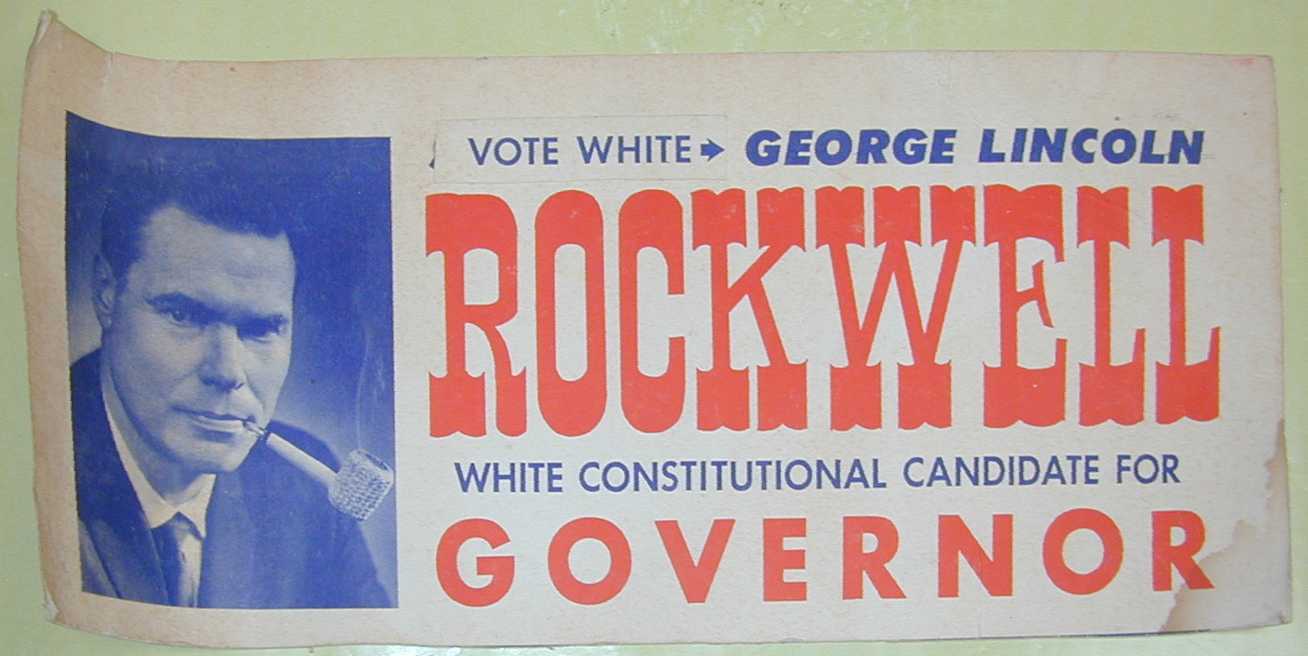
The first serious pro-Nazi group in the post-WWII USA was the American Nazi Party (originally "World Union of Free Enterprise National Socialists"), later known as the National Socialist White People's Party,[note 4] founded in 1959 by George Lincoln Rockwell, a U.S. Navy commander of both WWII and the Korean War, who had worked as a commercial artist, sign painter, cartoonist, photographer, advertising agent, and magazine publisher. Rockwell's group, which never had more than an estimated 100 dues-paying members,[40] made a splash in the media with rallies and marches of men in Nazi uniforms, as well as professionally designed propaganda (often the work of Rockwell himself) that promoted the party's philosophy, which included one the earliest accounts of Holocaust denial. His popularity included an interview for Playboy magazine in 1966[41] and an extensive speaking tour at American colleges, where he was invited to speak about his extremist views. Rockwell's two attempts at running for public office (as a write-in candidate for President in 1964 and an Independent candidate for Governor of[Virginia in 1965)[42] ended in embarrassing defeats.[43][note 5] He was fatally shot in 1967 at age 49 by a purged ex-member of his party in an Arlington, Virginia, laundromat parking lot.[44][45] Without Rockwell's leadership, the party eventually fractured into several smaller groups,[46] but his writings still influence the Neo-Nazis of today.
While there are several Neo-Nazi groups scattered about the USA, the National Socialist Movement (NSM), founded in 1974, based in Detroit, Michigan, and led by Jeff Schoep, is one of the few that can be rightly called a political party, since it has run candidates for office.[47] In January 2009, as part of the Adopt-A-Highway trash cleanup program, they sponsored a ½-mile section of US 160 outside Springfield, Missouri. The state legislature later renamed it the "Rabbi Abraham Joshua Heschel Memorial Highway", after the Jewish theologian who marched alongside Dr. Martin Luther King, Jr. during the Civil Rights campaign.[48][49]
Another major Neo-Nazi party was the Traditionalist Worker Party (TWP) (originally the "Traditionalist Youth Network"), founded in 2013 by Orthodox Christian, white nationalist, and racist Confederate supporter Matthew Heimbach. He proudly modeled his party policies after Nazism. The party disbanded in 2018 after Heimbach had a fistfight with party spokesman David Matthew “Matt” Parrott after Parrott caught Heimbach sleeping with his wife (On top of this, Heimbach was married to Parrott's stepdaughter from a previous marriage).[50][51]
Nazism in Europe today[edit]
The Nazi Party, the swastika, and nearly everything associated with Nazism, such as the Celtic cross, are currently illegal and banned in Germany and several surrounding countries, such as Austria and the Netherlands. Buildings in Germany and Austria that once displayed swastikas or other Nazi symbols that survived the war have been extensively cleansed of such imagery, if not torn down completely.[52]
Forty films made under the Nazi regime are officially classified as Vorbehaltsfilm (Restricted or Conditional films). The sale, exhibition, and distribution of these films (such as the costume drama Jud Suss ("Suss, the Jew") and the comedy Robert und Bertram, both with heavy Anti-Semitic content) are prohibited in Germany, except for use in academic situations. Exhibitors must have formal education in "media science and the history of the Holocaust."[53][54] The sale of many of these films is also prohibited in Austria, Italy, and France.
Germany has even changed the part of its National Anthem, "Deutschlandlied" ("Song of Germany") officially sung. Instead of the lyrics proclaiming "Deutschland, Deutschland über alles/Über alles in der Welt" ("Germany, Germany above everything/Above everything in the world"), only the third stanza is used, beginning with "Einigkeit und Recht und Freiheit/Für das Deutsche Vaterland" ("Unity and justice and freedom/For the German fatherland"). However, already in Weimar times, all three stanzas were the official German anthem, and only the Nazis commonly shortened it to only the first stanza being played. Contrary to popular belief, the first stanza is in no way illegal. The legal ground for anything being the national anthem is shaky at best, as it is not based on the constitution or any act of parliament but on two exchanges of open letters between the (figurehead) president and the chancellor, first between Adenauer and Heuss (the first holders of these offices) and then between Kohl and von Weizsäcker (the holder of said offices upon reunification).[55]
The first verse of the "Deutschlandlied" contains a geographical description of Germany that, while accurate at the time this song was made, is nowadays geographically inaccurate, as it spoke of Germany reaching up to the Memel. Nowadays, this river flows through Belarus, Lithuania, and Poland. Performing the first verse of this song wouldn't sit well with people from any of the three countries mentioned above.
The Nazi party anthem, "Horst-Wessel-Lied" ("The Horst Wessel Song"), also known as "Die Fahne hoch" ("The Flag on High"), once performed throughout Nazi Germany on par with the national anthem,[note 6] is now banned in both Germany and Austria, except for educational purposes.[note 7]
In popular culture[edit]

Endless multitudes of artistic works have contained references to and parodies of the Nazis. As an utterly humorless form of totalitarianism reeking of unwarranted self-importance, Nazism became the perfect target of works of satire, including:
- The film The Great Dictator (1940) by Charlie Chaplin. The title character is "Adenoid Hynkel", the Dictator of "Tomania".[note 8]
- The book Snorre Sel: En Fabel i Farger for Barn og Voksne (1941) by Frithjof Sælen was a satire of Nazi Germany and was translated into several languages (e.g., Snorri the Seal: A Fable in Colors for Adults and Children). The Nazis belatedly attempted to confiscate all copies in occupied Norway, where it was published.
- The children's book Yertle the Turtle and Other Stories (1951) by "Dr. Seuss" (Theodore Seuss Geisel) tells the story of a turtle who proclaims himself superior to all the others in the pond. In various interviews, Seuss stated that Yertle was a representation of Hitler.[56]
- The film The Producers (1968) by Mel Brooks, with its play-within-a-film (and later play-within-a-play) "Springtime for Hitler".[note 9]
- The film Snide and Prejudice (1997) is set in a mental hospital where patients can express their delusions by posing as historical members of the Nazi party. True to form, the patient posing as "Hitler" attempts to consolidate his power.[58]
- "Hitler reacts",[59] a YouTube meme based on a scene in the film Downfall (2004) (German title: Der Untergang) where Hitler blows a gasket and loses his shit on his subordinates (based on actual events, as described by survivors present in the Führerbunker at that time). For this meme, the parodist takes the unsubtitled clip from Downfall and adds humorous subtitles (that naturally do not reflect what Hitler is actually yelling about in the scene), making it look to people who read the subtitles - without paying attention to what's actually being yelled in German - as if Hitler is reacting to whatever the parodist wants.[60] Some parodists, who formed a community of YouTubers in the early 2010s called "Untergangers", take the parody-making game up a notch by editing Downfall characters into more absurd situations through advanced video editing techniques. The Unterganger community experienced a decline in recent years, however, as the rise of the alt-right and YouTube's increasingly censorious policies made Hitler memes practically verboten on the platform, not to mention that some Untergangers themselves have embraced right-wing ideologies, contrary to stated claims that they were making Hitler parodies more as a mockery of Nazism and a cautionary tale against it.
- Wolfenstein[61] is a well-known video game series featuring Nazis as the bad guys and allows players to mow them down with impunity with weapons ranging from ordinary to out-of-this-world. Wolfenstein 3D helped popularize the first-person shooter genre, while Wolfenstein: The New Order depicts a hypothetical Nazi victory using stolen ancient technology.
See also[edit]
- Organized crime
- Adolf Hitler
- Hitler and evolution
- World War II
- Waffen-SS
- Axis
- Holocaust
- Holocaust denial
- Genocide
- Neo-Nazism
- Anti-Semitism
- Stormfront
- Metapedia
- Christian Identity
- White supremacy
- Fraktur
- Delusions of grandeur
- Personality disorder
External links[edit]
- The I Was Not a Nazi Polka, The Chad Mitchell Trio
- California State University: In Our Own Backyard: Resisting Nazi Propaganda in Southern California 1933-1945
- Actual, literal grammar Nazis
- Short documentary on the German American Bund's 1939 New York Rally
- 1978 KPIX-TV report on Allen Vincent, leader of the San Francisco NSWPP unit
Notes[edit]
- ↑ Those high cultures were specifically the Babylonian, Egyptian, Chinese, Indian, Mesoamerican (Maya/Aztec), Classical (Greek/Roman), Arabian, Western or "European-American" societies.
- ↑ A fictionalized version of the Bund was depicted in the 1939 film Confessions of a Nazi Spy.
- ↑ Sources identify this man as Isadore Greenbaum, a 26-year-old unemployed plumber's assistant and former Merchant Marine from Brooklyn. He was later fined $25 (roughly $430 when adjusted for inflation) for Disturbing the Peace.
- ↑ Virginia apparently refused to allow the terms "Nazi" or "National Socialist" in names of incorporation, so the group's official business name was "George Lincoln Rockwell Party, Inc."
- ↑ His 1964 write-in campaign for the Presidency netted 212 votes, and he finished fourth out of four candidates in his 1965 Virginia run with only 5,730 votes, or 1.02% of the popular vote. He ran as an Independent because the Virginia electoral officers refused to allow the terms "Nazi" or "National Socialist" to be used on the ballot. He did, however, use "Vote White" as his campaign slogan.
- ↑ The standard way was to play the Nazi party anthem after or before the first stanza of the Lied der Deutschen
- ↑ The song's melody has been appropriated with different lyrics by several Fascist organizations, such as "Comrades, the Voices (of the Dead Battalions)" by the British Union of Fascists, "Banners of the Above" by the USA-based All-Russian Fascist Organization, and "Raise the Banners" by Greece's Golden Dawn.
- ↑ In Chaplin's 1964 autobiography, he wrote that if he knew of the horrors at the concentration camps at that time, he couldn't have made the film.
- ↑ "Springtime for Hitler" was likely inspired by the April 14, 1941 edition of Time magazine, which featured Hitler on the cover with the caption "Hitler: Spring is here. (World War)". The titular song of "Springtime for Hitler" also contains the lyric "Spring is here." The accompanying article in Time for that issue portrayed Hitler negatively but it was only for his irredentism rather than for his antisemitism, racism and autocracy.[57]:115-116
References[edit]
- ↑ Bloxham, Donald, The Final Solution: A Genocide (Oxford, 2009) p.24
- ↑ Or to give it its full, and somewhat clunky, Germanic title: Frühling in Atlantis: Roman aus der Blütezeit des Reiches Atlantis, which roughly translates as Spring in Atlantis: A Novel about the Flowering of the Atlantean Empire (1933).
- ↑ See for instance: Nicholas Goodrick-Clarke, Black Sun: Aryan Cults, Esoteric Nazism and the Politics of Identity (2002); Vanessa Ward, Nationalist Uses of the Atlantis Myth in a Nordic Framework, Pseudoarchaeology Research Archive (PARA) Research Paper A-10, January 26, 2008; Alicja Bemben, Rafał Borysławski, Justyna Jajszczok and Jakub Gajda (eds.) Cryptohistories (2015), particularly "Chapter Ten, The Riddle of Thule: The Search of the Crypto-History of a Racially Pure White Utopia"; Manfred Nagl, SF, Occult Sciences, and Nazi Myths, Science Fiction Studies, Volume 1, No. 3, Spring 1974.
- ↑ Twitter[a w]
- ↑ Fritzsche, Peter. Germans into Nazis, Cambridge, Mass.: Harvard University Press, 1998; Eatwell, Roger. Fascism, A History. Viking-Penguin, 1996. pp. xvii-xxiv, 21, 26–31, 114–140, 352; Griffin, Roger, "Revolution from the Right: Fascism," in David Parker, ed., Revolutions and the Revolutionary Tradition in the West 1560-1991, London: Routledge, 2000
- ↑ Public Health under the 3rd Reich, US Holocaust Memorial Museum
- ↑ https://www.youtube.com/watch?v=H-2q-QMUIgY Crash Course World History #220, World War II, A War for Resources.
- ↑ http://www.nazism.net/about/ideological_theory/
- ↑ See the Wikipedia article on Nazism § Religion.
- ↑ "National Socialist and Christian concepts are irreconcilable. The Christian churches build upon man's ignorance and endeavor to keep the greatest possible number of people in a state of ignorance. For it is only in this fashion that the churches can maintain their power. National Socialism, on the other hand, rests on scientific[sic] foundations. Christianity has certain unalterable principles, established nearly two thousand years ago, petrified into a dogmatic system that is even further removed from reality. National Socialism, on the other hand, if it is to fulfill its purpose, must forever be brought in harmony with the latest results of scientific inquiry.[sic]" -Bormann
- ↑ Trial of the Major War Criminals before an International Tribune, Nuremberg War Trials
- ↑ Himmer and religion, worldfuturefund.org
- ↑ "My feelings as a Christian points me to my Lord and Savior as a fighter. It points me to the man who once in loneliness, surrounded by a few followers, recognized these Jews for what they were, and summoned men to fight against them and who, God’s truth!, was greatest not as a sufferer but as a fighter." - Adolf Hitler, April 12, 1922, Munich speech
- ↑ Besier, Gerhard and Francesca Piombo: The Holy See and Hitler's Germany (2007)
- ↑ , Kevin P. Spicer: Hitler's Priests: Catholic Clergy and National Socialism (2008)
- ↑ See, for example, this biased and selective website
- ↑ John Cornwell's
disasterhack jobbook Hitler's Pope: The Secret History of Pius XII is probably the most prominent example. - ↑ WWII-era letter suggests Vatican knew of Holocaust atrocities by Sammy Westfall (September 17, 2023 at 11:19 p.m. EDT) The Washington Post.
- ↑ The Pope at War David Kertzer.
- ↑ The Pope at War: The Secret History of Pius XII, Mussolini, and Hitler by David I. Kertzer (2023) Random House. ISBN 0812989961.
- ↑ https://www.newyorker.com/news/george-packer/islamized-germans
- ↑ https://www.davnet.org/kevin/articles/table.html
- ↑ Goebbels Diaries, 29 December 1939
- ↑ Joseph Goebbels, diary entry for October 16, 1928.
- ↑ 25.0 25.1 Hitler's Renegades, by Christer Jorgensen
- ↑ http://www.ibtimes.com/heinrich-himmler-nazi-hindu-214444
- ↑ http://org.law.rutgers.edu/publications/law-religion/articles/RJLR_3_1_2.pdf
- ↑ "Bund" (pronounced "booned") is German for "federation."
- ↑ No relation to the Green Party politician with a similar name.
- ↑ A camp was planned for the Kettletown section of Southbury, Connecticut, but construction was prevented after local residents who opposed the Bund had the zoning laws changed.
- ↑ Click Magazine: "The Nazis In America", August 1938
- ↑ The Nazi propaganda film "Hitlerjunge Quex (Hitler Youth Quex)", under the title Unsere Fahne flattert uns voran (Our Flags Flutter Before Us), had its USA premiere at the Yorkville Theater in Manhattan on 6 July 1934.
- ↑ Coronet Magazine: "Hitler Despises German-Americans", April 1941
- ↑ This was the subject of the 2017 documentary short film "A Night at the Garden"
- ↑ Number taken from Arnie Bernstein's book Swastika Nation: Fritz Kuhn and the Rise and Fall of the German-American Bund
- ↑ Footage of German American Bund activity
- ↑ US Holocaust Memorial Museum: German American Bund
- ↑ FBI Records: German American Federation/Bund
- ↑ Failuremag.com: Fritz Kuhn and the German-American Bund
- ↑ Number taken from a declassified 1965 declassified FBI monograph on the American Nazi Party
- ↑ 1966 Playboy interview of George Lincoln Rockwell
- ↑ Promotional poster for Rockwell's 1965 run for Virginia Governor
- ↑ George Lincoln Rockwell 1965 Virginia Gubernatorial Promotional film (WARNING: Racist language)
- ↑ Murderpedia article on John Palter
- ↑ Death of an Arlington Nazi, Northern Virginia Magazine
- ↑ The quasi-religious organization New Order, led by former Rockwell follower Matthias "Matt" Koehl (1935-2014), is considered to be the "official" successor to Rockwell's group. Another Rockwell follower, William Luther Pierce (1933-2002), would later found the National Alliance. Yet another Rockwell follower, Allen Vincent (1932-1999), was the leader of the San Francisco, California unit of the NSWPP. He was featured in the 1975 documentary "The California Reich"
- ↑ Their best showing at the polls was in 2010, when Jeff Hall openly ran as an NSM candidate for a seat on the Western Municipal Water Board in Riverside County, California[1], finishing 2nd of 2 candidates with 27.66% of the votes[2]. The following year, Hall was murdered by his own son[3].
- ↑ Jewish Times; "Highway To Heschel", May 30, 2013,
- ↑ His daughter, Prof. Susannah Heschel, objected to this.
- ↑ Daily Beast:Neo-Nazi Group Implodes Over Love Triangle Turned Trailer Brawl March 14, 2018
- ↑ Heimbach later became "Director of Community Outreach" for the National Socialist Movement
- ↑ Geoff Walden's website "Third Reich In Ruins"
- ↑ German Wikipedia article on Vorbehaltsfilm
- ↑ The 2014 German documentary Verbotene Filme (Forbidden Films) deals in-depth on these works.
- ↑ see this section of the Wikipedia article on the details
- ↑ http://mentalfloss.com/article/28843/10-stories-behind-dr-seuss-stories
- ↑ The American Ascendancy: How the United States Gained and Wielded Global Dominance by Michael H. Hunt (2007) University of North Carolina Press. ISBN 0807830909.
- ↑ http://www.imdb.com/title/tt0120833/
- ↑ http://knowyourmeme.com/memes/downfall-hitler-reacts
- ↑ Hitler Downfall parodies: 25 worth watching: Subtitled parodies of Adolf Hitler's last days in the Berlin bunker, as depicted in the 2004 Second World War film Downfall, have become one of the web's most enduring memes (7:00AM BST 06 Oct 2009) The Telegraph.
- ↑ https://nationalinterest.org/blog/buzz/video-game-portrays-hitler-winning-world-war-ii-130657