Infinity


| Part of a convergent series on Mathematics |

|
| 1+1=11 |

Infinity (Unicode: ∞ or U+221E),[1] often denoted , is, in layman terms, the biggest numberDo You Believe That? (it is not a number, however). The concept of infinity has been one of the most heavily debated philosophical concepts of all time.[citation needed]

So what is infinity? Infinity is not just a really big thing; it is a thing that keeps going without limit, but that is already complete. Infinity is not a number, and cannot be treated like a number. The days of the week are finite, there are also seven of them. The number of fractions between 1 and 7 is not finite. A set is called countably infinite or denumerable if the elements from the set can be put into a one-to-one correspondence with the natural (counting) numbers. More plainly, if a set is countably infinite, it means we can just make a list of all its elements: for example, the even natural numbers are a countable set, since we can just list them off as "2, 4, 6,…" An uncountably infinite set, like the real numbers , is any other infinite set: one with too many elements to be put in a such a list. For example, it turns out that there are so many real numbers that it's impossible to just write them all down one after another, even in an infinitely-long list.


Now it gets tricky[edit]
Let us consider the sequence: 1, 1/2, 1/4, 1/8, and so on.[note 1] This sequence is infinite because whenever you find a number in this sequence, such as 1/1024, you can find the next number in the sequence, in this case 1/2048. Let's say that we want to add them all up. Let:
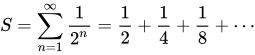
You would expect that adding up an infinite number of numbers should result in infinity, right? However, look at the first few terms:
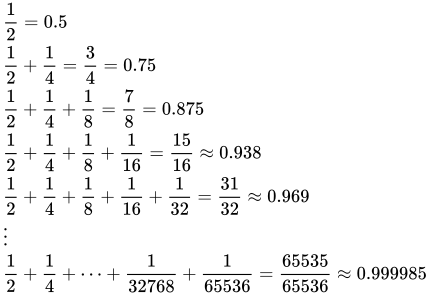
As we add up more and more of the numbers in our sequence, the sum gets closer and closer to 1. This phenomenon is called "convergence", and when it happens, it seems sensible to say that when we add up these infinitely many numbers, we get a finite sum – in this case, 1.
It's not true that every infinite sum converges, even if the terms are getting smaller and smaller. For example,
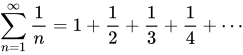
doesn't converge: as we add up more and more terms, the sum just keeps getting bigger.
A similar idea is found in the integration of functions. For example, suppose a particle has velocity given by
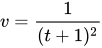
with in meters per second and in seconds, and we want to know how far it will have traveled after an infinite amount of time. Even though its velocity is always positive and greater than 0 (i.e. it keeps moving in the same direction and does not stop), it does not cover an infinite distance in this infinite time. Rather, when we integrate the velocity function (so as to obtain displacement), we obtain a value of one meter as follows.


Different sizes of infinity?![edit]
The cardinality of the natural numbers is denoted (pronounced "AL-ef NULL"), and is the lowest non-finite cardinal number.[2] That a one-to-one correspondence, a bijection, between the natural numbers and the rational numbers exists means that their cardinalities are the same. However, no such bijection exists for the real numbers, – there are too many real numbers to put them in a simple list (i.e., a bijection with the integers). This was first proven by Cantor in a complex 1874 paper; a key simplification was the diagonal method, discovered by Cantor 17 years later.


Why is there no bijection? Suppose there was, and use the one-to-one correspondence between the reals and the natural numbers to make a list of all the real numbers between 0 and 1, by putting the first, then the second, etc:
- 0.5435894098756…
- 0.9128301293821…
- 0.2143123902191…
- 0.0984324324432…

But now we make a reductio ad absurdum. Construct a new number in the following manner. Let the first digit of after the decimal point be one greater than the first digit in the original decimal. In the case of a 9 in the original, subtract one.[2] In this case, that means not 5, so will start with 6. For the second digit, follow the same rule. Here, that means not 1, so add one, and we'll use 2. We continue in this manner, picking the digit of to be one greater than (or less than in the case of a 9) the digit of the number in the list. So in the above we might take starting .



The posited list of real numbers above is supposed to contain all of them, and so the number that we constructed above must be somewhere in the list, say in the 1000th spot. But this isn't possible: the 1000th digit of is different from the 1000th digit of the 1000th number (call it ) in the list, by construction of ! So can't be the 1000th digit in the list, or anywhere else in the list, for the same reason. Thus it's not in the list at all, and the list wasn't complete to start with, contradicting countability.

This is called the "diagonalization argument" and was discovered by Cantor himself. We've glossed over some details above (e.g. the fact that two decimal expansions can determine the same real number), but it's basically correct. In the original proof Cantor used binary decimals (1 and 0) and their complements to show the validity of his diagonal argument.
So there are different infinite cardinals. But how many? This brings us to the continuum hypothesis. It can be shown that the cardinality of is equal to that of the power set of . The power set is the set of all subsets of any particular set. Power sets have cardinality , where is the cardinality of the original set. Thus the reals have cardinality , which is often denoted , the cardinality of the continuum. It is also known as ("beth one") as the beth numbers are defined by and .


The continuum hypothesis (CH) states that there is no cardinal number lying between and , that is to say, there's no set with more elements than the integers but fewer elements than the real numbers. This turns out to be a very tricky claim, and now it's known that the continuum hypothesis can't be proved or disproved using the usual axioms of mathematics (i.e. ZFC).
The generalised continuum hypothesis (GCH) states that for all ordinals . So the continuum hypothesis is a special case of the generalised continuum hypothesis for ordinal . Like CH, GCH is independent of the axioms of ZFC.


A set having cardinality equal to or less than is called countable; a set of greater cardinality is called uncountable.
Ordinals[edit]
Numbers serve two distinct purposes – to measure the size of sets, and to measure the position of an item in an ordering. Thus, we may speak of a race having 2, 3, 4, 5, etc. contestants, and we can speak of the contestants as having come 1st, 2nd, 3rd etc. (or even 0th, if one is a mathematician!) When we measure the number of elements in a set, we are using cardinal numbers; when we measure an item's position in an ordering, we are using ordinal numbers. For finite quantities, it does not make that much difference, since for finite quantities we can use the same numbers to serve both purposes. But for transfinite quantities, that is no longer the case — we can no longer use the same numbers as both cardinals and ordinals. Thus, the smallest transfinite cardinal is , but the smallest transfinite ordinal is .

Ordinals are a finer division than cardinals: for each infinite cardinal, there are infinitely many ordinals with that cardinality.
Other types of infinite numbers[edit]
Other than transfinite cardinals and ordinals, there are other types of infinite numbers:
- The affinely extended reals: these are elements of the set . In other words, the real numbers extended by the addition of positive and negative infinity. is greater than every real number, and is less than every real number.
- The projectively extended reals: these are elements of the set . In other words, the real numbers extended by the addition of a single unsigned infinity. The order relation is not defined for the projectively extended reals – informally, can be thought of as both greater and less than every real number.
- The hyperreals: denoted , these extend the real numbers with both infinite and infinitesimal quantities. They are used in non-standard analysis.
- The supernatural numbers: these extend the positive integers with numbers having infinitely many prime factors. They are used in number theory.
- Other extensions of the real numbers with infinite and infinitesimal quantities include the surreal numbers, the superreal numbers, and the Levi-Civita field.



The conclusion to be drawn from all of this, is that although in popular usage some speak about infinity as if it were a single thing, there are actually numerous different infinities, all belonging to different systems. If we want to talk about infinity, we ought to carefully specify which infinity we mean. In this light, claims such as God is infinite are particularly incomprehensible, because those who propose them never define which infinity they are using to describe God, or in what way God is infinite.
Archimedean property[edit]
An ordered field is said to be Archimedean if it has no infinitely large or infinitely small elements. One way of stating this: an ordered field is Archimedean, if for every element of the field, there is a greater natural number. (Here, natural numbers are defined as iterated sums of 1, where 1 is the multiplicative identity guaranteed by the field axioms.) This is true for the reals – for every real number, there is a greater natural number –- but not for example for the hyperreals, since it contains infinite numbers greater than every natural number. Likewise, the hyperreal numbers, the surreal numbers, the superreal numbers, and the Levi-Civita field are all non-Archimedian.
Philosophy of mathematics[edit]
Different positions in the philosophy of mathematics have different attitudes towards infinity. At one extreme, Platonists and formalists generally have no philosophical objection to any form of infinity that can be defined.[citation needed] At the other extreme, finitists and ultrafinitists deny the existence of infinity; to them, only finite quantities, and finite objects, actually exist.[citation needed] In the middle, many constructivists and intuitionists adopt a position of countablism – an acceptance of the existence of countable sets, but denying that uncountable sets exist.[citation needed]
Misapplications[edit]
Outside mathematics, the concept of infinity is often used to draw exciting but fallacious conclusions. For example:
- The universe is infinite, so everything that can be imagined must exist somewhere! — Er, why?[note 2] Also, physical impossibilities can be imagined, but cannot occur anywhere in the universe.
- If you were immortal, you'd eventually have every experience it's possible to have — Or you might just walk round in a big circle the whole time.
- Since time is infinite, every prophecy ever made will eventually come true — Great!
To infinity… and beyond!
- Buzz Lightyear, presumably not comparing varieties of infinite number
 ). However, there's an infinite difference between "infinite" and "so ludicrously big that we cannot measure its actual size but after all finite".