Dungeons & Dragons
| You gotta spin it to win it Media |

|
| Stop the presses! |
| We want pictures of Spider-Man! |
| Extra! Extra! |
Dungeons & Dragons (usually abbreviated D&D) is a role-playing game system. In fact, it is in many ways the great role-playing game system, being the first one ever developed and selling better than all other RPGs combined. D&D was created in 1974 by David Arneson and E. Gary Gygax as an outgrowth of their miniatures wargame hobby. The game was originally published by Tactical Studies Rules (aka TSR Hobbies); in 1997, TSR was acquired by Wizards of the Coast, which in turn became a subsidiary of Hasbro in 1999.
What D&D is actually like[edit]
D&D can best be described as a cross between improvisational theatre and a board game. Like most tabletop RPGs, D&D basically looks like a bunch of nerds sitting around a table and talking about orcs. This is moderately true, though as one Cracked article pointed out, this being a social gathering already puts it a step ahead of most nerd pursuits.[1]
One of the players is the "Dungeon Master", or DM (sometimes called a Game Master or GM, or simply the "referee"), whose job is to explain what is happening, set various challenges for the other players to meet, and move the plot of the story (referred to as a "campaign", "scenario", or "adventure").
The other players are the "party". Each player in the party creates an avatar within the game, called a "Player Character" (PC) by the players who prefer the board-game side or an "Adventurer" by the players who prefer the improv-theater side. But by 1981 the game eventually came in two flavors: the boxed sets (D&D) and the books for the Advanced version or AD&D for short. Realizing that having two lines of the game was confusing (the boxed set had Basic and Expert editions if things weren't confusing enough) TSR dropped the D&D box line in 1991.
The main factors determining the powers of the PCs are their "race", usually selected from fantasy archetypes like elves, dwarves and gnomes, and their "class", selected again from fantasy archetypes like monks, wizards and clerics, which includes druids and in a sense paladins. One other factor in character creation (which matters more to some players than others) is your character's moral alignment, which is a rough guide to how they will behave in a moral dilemma. In D&D, characters' alignment was a straight line of Chaotic, Neutral, and Lawful while in AD&D, a character's alignment fell on a Cartesian plane, where one axis goes from "good" to "evil", and the other goes from "lawful" to "chaotic". The addition of a "neutral" middle ground to both scales creates 9 possible alignments.
In theory, these alignments were supposed to be absolutes but some DMs treated them as relative. The problem was that alignments as absolutes resulted in situations like that described in Roger E. Moore's Dragon #51 (July 1981) "It's not easy being good" where the player was basically hosed regardless of their choice (kill the Talbot-like werewolves and your Paladin does penance[note 1] because due to their split personality he killed 'innocents'; let the Talbot-like werewolves go and your Paladin still does penance because he did not stop 'evil'). The "alignments as relative" view had its own set of problems as anything that pinged 'evil' could be fair game to be slaughtered by 'good' characters—a situation carried to its logical extreme in the satire character Kore the Paladin in the online comic Goblin who can kill anything he deems 'evil' and retain his Paladin status. Because of this inconstancy, alignment became one of the most maligned (ha ha, see what we did there?) things in D&D with articles like Paul Suttie's "For king and country" (Dragon #101 September 1985) suggesting alternatives.
Because it grew out of the medieval miniature wargame Chainmail, D&D has always been strongest with combat and weakest in other RPG elements like seducing wenches or even navigating an unknown area. In the TSR days, it was obvious that all non-combat options were put into the game as an afterthought and even now the game is still focused towards combat, since it's combat that makes you gain experience and level up, but most non-evil DMs will also award experience for non-combat things (like finding clever solutions to thorny challenges).
D&D uses various dice as a random chance generator, mostly to determine the outcome of fights with monsters and villains. However, especially for the most recent iterations of the game, dice, along with tables, can allow games to be played virtually entirely by chance. Early versions of the game tried to focus on the players figuring out how to do things they wanted their characters to do. However, by the advent of the third edition, most attempts to perform special tasks were handled by specific rules, and their outcome was determined entirely by die roll. For instance, in the first edition, the DM might ask a player how they planned to search the floor for traps (they might tap with a staff, check for cracks in the floor, etc.), while in later editions, the character would simply roll against their character's "perception" skill. In gaming circles, this is often termed "roll-playing" as opposed to "role-playing".
The dice for each player typically come in a 7-piece set, and are designated by how many sides they have (a standard 6-sided die, part of balanced breakfasts everywhere, is designated "1d6"). For D&D, the set contains 1d4, 1d6, 1d8, 2d10 (to generate a random percentage, both are rolled), 1d12, and, the most commonly used, 1d20. While all the other dice are primarily for table generation and damage rolls, d20 can simulate virtually all actions except damage; because of this, the extremes of 1 and 20 are known as critical rolls, of failure and success, respectively. Depending on player needs, the set can reduce to one to as many as twenty dice, simplifying what could be one of the most intimidating parts of the game for newer and older players alike.
D&D and the religious right[edit]
For some reason, D&D has always been the target of considerable belligerence from conservative Christians, reaching its height in the 1980s. Some of their many absurd claims have included:
- Roleplaying games make the participants more prone to suicide or mental illnesses.[note 2]
- The inclusion of magic and supernatural creatures such as devils and demons makes roleplaying equal to practicing sorcery and witchcraft, or at least promotes such activities.[2]
- The alleged emphasis on accumulation of wealth and personal power in the game is incompatible with the Christian message. (Huh. Now how did Phyllis and Andrew Schlafly as well as certain televangelists become so rich?)
- The rule books contain "pornographic artwork".[note 3]
- The inclusion of polytheistic deities worshipped by the game characters[note 4] is blasphemous,[note 5] and it's often equalled to devil worship.[note 6]
- And so on and so forth.
The irony of this (or at least part of the irony) is that D&D actually builds on elements from the Western Christian cultural heritage to a considerable extent. Besides the obvious elements, such as inclusion of "angels", "paladins",[note 7] and deities inspired by Christianity[note 8], this is probably most apparent in the game's very naïve worldview, which presents a system of overly simplistic moral absolutes that categorize a character (or even whole races or societies) with one of nine different "alignments" by placing them on two different axes of morality: Good/Evil and Lawful/Chaotic.[3] By comparison, most other role-playing games are much more morally ambiguous, such as White Wolf's various World of Darkness products or Chaosium's Call of Cthulhu RPG, or at least prefer to consider the individual personalities and motivations of the characters, rather than placing them in the hopelessly optimistic dualistic good vs. evil moral matrix found in D&D.[note 9]
Despite this, D&D has always been the favorite target for the "concerned" people, probably due to a combination of the game's status as the archetypal RPG, and ignorance that the other games even exist. BADD, a (now thankfully defunct) organisation opposed to D&D, is an example of this.[note 10] The makers of D&D even acquiesced to some complaints, such as renaming Hell as "Baator," demons as "tanar'ri," and so on.
Thankfully, most of the criticism fell by the wayside in the 1990s, when D&D both declined in popularity and began catering to older players, and by 2000 the game reverted to its previous terminology ("demons", "Hell", etc.), no longer concerned with the opinions of a few fringe kooks.
In any case, it is quite clear why the game has attracted the level of hostility that it has. After all, it almost goes without saying that any game that teaches such skills as...
- Improvisation
- Creativity
- Vocabulary[note 11]
- Open-mindedness
- Social skills
- Strategy
- Group management and group dynamics
- Empathy
- Self-insight
- Game theory
- Probability
- History[note 12]
- Knowledge of other cultures[note 13]
- Other basic math concepts (such as percentages and simple accounting)
...must almost by necessity find itself the target of widespread fear and loathing from large parts of the religious right. Why, the young people might start actually thinking for themselves!
D&D vs. its own players[edit]
During its tenure as the flagship product of TSR, Inc., D&D was the undisputed king of the role-playing world. However, the market changed and TSR became notoriously *ahem* protective of its trademarks and system, often suing those who dared adapt D&D rules to their own products without TSR's permission with an almost estate-of-Tolkien-ian (that had tried similar stunts before, attempting to copyright words as "dragon", "elf", "orc", or "ent" despite such words and entities having existed in mythology and legends for many centuries before Tolkien had been born)[4] zeal (rather ironic, since Gygax had lifted massive amounts of the Lord of the Rings mythos wholesale for his settings, not to mention the works of Robert E. Howard, Fritz Lieber, Poul Anderson, Jack Vance, and Michael Moorcock). Anything TSR even felt violated its copyright no matter how nonsensical (such as claiming no one else could use the world "dragon") might as well have painted a big bullseye on it. It got so bad that it was suggested that TSR really stood for "They Sue Regularly".[5]
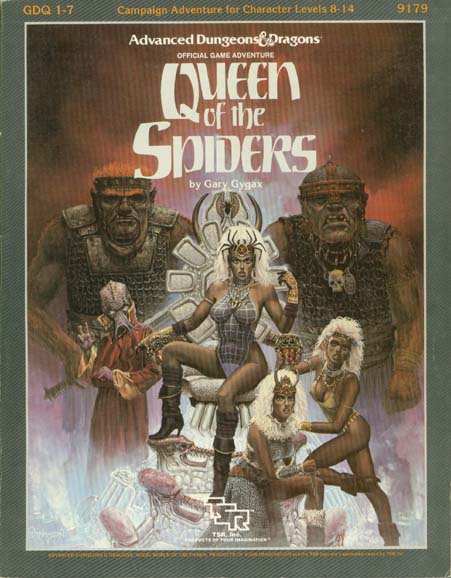
At least a few D&D players felt varying degrees of contempt for TSR given its rapid and zealous attacks and threats of legal action against people in the game community who dared to use any term relating to TSR without copyright and trademark symbols, yet TSR never seemed to go after anyone who attacked them outside the game community. They never sued anyone like Geraldo Rivera who slandered D&D by saying it was responsible for deaths it was clearly not responsible for. Some gamers felt that TSR was a big bully in the game world, but didn't have the guts to fight anyone outside it. Worse, TSR had become incredibly hostile to everyone, not just fans; business partners and even former associates had to deal with micromanaging of every bit of detail in licensing agreements. It didn't help that at times TSR seemed to demonstrate all the social awareness of a rock; how else can one explain the 1986 cover for GD 1-7 Queen of Spiders which depicted the Drow (evil elves with dark skin) as if they had just fallen out of the Shaka Zulu miniseries?
How to mess up, fix, mess up again, and fix a brand[edit]
One theory as to why TSR ended up in the ground is that they had developed a Many Buckets Theory, resulting in a "lot of product lines" which "instead of supporting the main Dungeons & Dragons line, fragmented the marketplace."[6] So the players were still giving TSR the same amount of money as before but now there was this additional financial burden of creating, producing, and supporting hundreds of products outside of the main line. Worse, "As the settings grew more popular, they began to diverge from one another, advancing along their chosen philosophical paths, essentially becoming their own separate games" until "players had stopped identifying themselves as D&D players and were instead identifying themselves by the setting they played in. A Planescape player was very different than a Forgotten Realms player, and their rule systems were beginning to become incompatible with each other. More significant from the company's point of view, though, was that players would never buy a product set in any other setting than their own. Far from catching more money in their small buckets, TSR was actually making the audience smaller!"[7]
This is why, after TSR collapsed and Wizards of the Coast bought the smoldering remnants, WotC lightened up, creating the Open Gaming License (an application of open source well outside its traditional stomping grounds of software design) and releasing the fundamentals of the rules as the d20 system SRD (System Reference Document), essentially the rules from D&D third edition with the serial numbers filed off.[note 14] as well as taking many settings (such as Ravenloft) and licensing them to other companies or (like Spelljammer) effectively making them open source.
The d20 Modern game -- stylistically sort of a cross between D&D and the modern goth-horror games of White Wolf's World of Darkness -- is derived directly from the D&D 3e rules and has its own SRD.
The d20 SRD is a great document to have for the gamer running a campaign on the cheap, or for a game designer who likes D&D rules and wants to create their own setting. Unfortunately there's one thing that is inescapable -- you still need all those goddamned dice, and a d4 by any other name still hurts like hell when you step on it.
In 2008, though, Wizards of the Coast released D&D Fourth Edition, which attempted to address myriad mechanical flaws that had been located and picked apart over the years of 3rd edition's run, as well as taking a critical eye to the large, sprawling body of lore inherited from TSR's era and attempting to create something new, but yet which also felt like "D&D". The result was immensely divisive, with complaints ranging from legitimate criticisms of entirely new mechanical errors that had crept in (most notoriously, combat in the initial release was very sluggish because WotC had been overly generous with monster health and inadequately generous with things for monsters to do) to purely emotion-based backlash against changes in lore, art-style and basic class design.[8][9][10] Perhaps the biggest error that WotC made with the edition was canceling its former policy of open source, which gave them exclusive control over D&D content but also angered many fans. This led Paizo Publishing, which had previously been the most notable producer of OGL-related content, to release their own roleplaying game of "Pathfinder", which was deliberately advertised as the "Edition 3.75" that many fans had expected Fourth Edition to be.
In 2010, Wizards of the Coast released D&D Essentials, an attempt to create an "Edition 4.5" in hopes of winning back the fans they'd lost to Pathfinder. The result was essentially a failure; it was still too "4th edition-like" for the Pathfinder fans, and it alienated the fans of 4th edition for trying to to be too much like 3rd edition. As a result, Wizards saw the writing on the wall and began planning another complete edition relaunch, this time taking advantage of the Internet by using beta-tester players and publicity polls as information gathering to base the result ground-up rework of their lore and mechanics.
In 2014, Dungeons & Dragons 5th Edition formally launched. Today, D&D is as popular as it ever was, if not more so. Several theories exist as to why that is.[11] One possible reason is the newbie-friendliness of 5th Edition in general, with certain products like the Starter Set and Essentials Kit designed to allow inexperienced players and dungeon masters to quickly get into the game using only the most basic rules. Other factors include popular live and web-based shows like Acquisitions Incorporated and Critical Role where people just play D&D for several hours, significant mentions of D&D in popular shows like Community and Stranger Things, the growing popularity of fantasy in general thanks to shows like Game of Thrones and video games like Skyrim and The Witcher, WOTC promoting D&D to other fandoms (like with their crossover comic and gamebook with Rick and Morty), and getting several celebrities (including bigger names like Vin Diesel and Stephen Colbert) to help them promote the game. The restoration of the Open Game License in 2016 probably also helped a lot, since it had been such a massive bone of contention in 4th edition.
At present, Wizards is currently doing public playtesting for D&D One, an updated and rebalanced version of 5th edition’s ruleset that is scheduled to release for D&D’s 50th anniversary in 2024. Pathfinder is also still around as Pathfinder 2nd edition, released in 2019 and taking a mix of cues from Pathfinder 1st edition, Paizo’s science fantasy RPG Starfinder, D&D 5th edition, some of 4th edition, and other tabletop roleplaying systems, though it hardly has the numbers of 5e.
D&D and religion[edit]
Interestingly, if someone believed D&D mythology as being real, and that their books & commands are real, they would be called an outrageous nerd, possibly insane, and if they even entertained hurting others based on those books, outright insane.
On the other hand, when religious nerds believe certain books & mythologies are real, it is called "having spirituality". Worse, acts of hurting someone based on those works are often sugar-coated as "religious freedom" & "beliefs".
The funny thing is that the game's co-creator, E. Gary Gygax, was a devout Christian himself.[12] He even refused to allow angels to be published as "monsters" in the game because allowing players to kill them bothered him. (He did include/allow the angel-like "devas", but that's beside the point.) The difference between Gygax and those who believed he promoted Satanism was that when Gygax pretended to be a righteous crusader against evil, he knew it was all in his head. Of course, during the whole satanic panic about D&D, he refused to publicly mention that he was Christian. This may seem like a callous treatment of his fans and the community he had helped create, but is much more understandable (if still unethical) in the context of denying the religious argument any legitimacy.
Pat Robertson has cast True Resurrection on this particular brand of hysteria.[13]
The biggest laugh is the claim that D&D (and later AD&D) allowed one to cast "real" spells. The reality is that to avoid using any real-world magic system, D&D effectively stoleborrowed the memorize, cast and forget magic system (known in RPG circles as "Vancian" magic) from Jack Vance's The Dying Earth, which has gone through modifications in each edition, with other magic systems (such as sorcery, chi and psionics) added to complement it. And while the game did list material components necessary for many spells, it almost never gave instructions for how to actually cast a spell; and the very few times it did, the descriptions were intentionally humorous, such as the instructions for casting the Firefinger cantrip: "To bring about the magic of this cantrip, the caster speaks a word of power over elemental fire (such as ron-son, zip-po, or the much revered word, dun-hill), extends the forefinger, and makes a sideways motion with the thumb." Maybe because D&D magic was never meant to be mistaken for real, honest-to-God magic spells that could be cast in the real world.[note 15]
See also[edit]

|
For those of you in the mood, RationalWiki has a fun article about Dungeons and Dragons. |
External links[edit]
- Dungeons and Dragons website
- The WotC d20 System website, including the System Reference Documents for d20 fantasy and d20 Modern
- The Paizo Publishing website for Pathfinder, whose 1st edition was formally a clone of 3/3.5e (often called 3.75e). It currently advertises Pathfinder 2nd edition, which takes more steps to separate and streamline the mechanics from its Wizards of the Coast counterpart, but is still very much a sister system to D&D.
- Hypertext d20 srd: the SRDs for D&D 3.5 and 5.x.
Notes[edit]
- ↑ Losing, like a cleric who has voluntarily acted in ways contrary to his/her deity/faith, his/her divine granted powers until atoning his/her faults (pity there's no equivalent of this in the real world)
- ↑ Much of this seems to come from Patricia Pulling
- ↑ Examples include the 1995 edition's female wizard in a yellow platemail bikini, AD&D 1e's scraggly-looking bare-chested succubus with a bad facelift, and the harpy in the 3e Monster Manual. Penthouse it's not - ironically there are unofficial supplements for (at least) the Third Edition, such as the Book of Erotic Fantasy, that is said to have been unpublished by WotC due to its adult content, and the original Forgotten Realms setting as depicted by its author has quite more adult and darker overtones having been sanitized a lot.
- ↑ Ironically, in most settings, a character has just one patron deity worshipped by them even if they are not a cleric and the like (e.g. druid) instead of what would happen in a real polytheistic system, and worshipping others may even be seen as either weird or blasphemous
- ↑ It's worth noting that because of the way D&D settings work, there is no singular deity system anyways, so any real person attempting to worship D&D gods would go through a hassle deciding which setting to follow even if some can be found on several, and besides some deities being based on real-world ones presumably to avoid giving the game a Neopagan look as noted below some of the latter have been adapted for the game too.
- ↑ Even if good/neutral deities/faiths are more abundant than evil ones, some of the former are modelled after Abrahamic ones, and even the most fluff-abundant supplements, back in the AD&D days, do not delve very much in exact details of rites, ceremonies (as in describing them with the detail one would describe a real life Catholic Mass), architecture of temples, etc. Note also that those that demand human(oid) sacrifices and the like are evil.
- ↑ Modeled on the knights of King Arthur and other parts of the Chanson de geste tradition, especially characters like Parzifal and Lohengrin.
- ↑ As Ilmater in Forgotten Realms, and especially Saint Cuthbert

- ↑ Back in the AD&D days supplements discouraged playing evil-aligned characters and as can be seen here, TSR had an internal Code of Ethics.
- ↑ In one case it was to the point that in "Chicago there is a wing of the Hartgrove Hospital called for the Center for the Treatment of Ritualistic Deviance. It's influenced by silly Satanism seminars, and one of the criteria for being a potential patient is "heavy involvement in fantasy and role play [sic] games". Therefore, a young teen can be "hospitalized" here with the consent of his parents for being a D&D-player--all legal and proper!" From In Pursuit of Satan: The Police and the Occult as documented in Satanists and D&D usenet thread.
- ↑ Admit it, D&D was the first place you ever heard of a glaive-guisarme or a codex.
- ↑ Back in the AD&D days there were supplements describing from a historic perspective stuff as Celts, Charlemagne's Paladins, etc. and weapons and armor types had often brief descriptions of their historic context.
- ↑ As a number of countries, cultures, etc. of the different settings are more or less based on real life ones (emphasis on based, this is a game and not an anthropology lesson). In some of them as in Forgotten Realms even their pantheons (see Ancient Egypt, er, Mulhorand) or at the very least individual deities (just ask Tyr or Mielikki) were adapted
- ↑ Oddly enough, the System Reference Document to the d20 system is enough to run a pretty decent D&D campaign all on its own, with maybe a second-hand copy of a second edition Monster Manual to fill in the blanks.
- ↑ While it's mentioned clerics and the like pray to obtain spells and some are named "prayers", they also use the Vancian system, and there's almost no details of how to obtain or cast them
References[edit]
- ↑ The 6 Most Insane Moral Panics in American History
- ↑ See the totally (unintentionally) hilarious "Dark Dungeons" Chick tract
- ↑ See the Wikipedia article on Alignment (Dungeons & Dragons).
- ↑ Lord Of The Rings' Complicated Legal History With Dungeons & Dragons
- ↑ Magic & Memories: The Complete History of Dungeons & Dragons - Part III page 3 Gamespy
- ↑ Magic & Memories: The Complete History of Dungeons & Dragons - Part III page 2 Gamespy
- ↑ Magic & Memories: The Complete History of Dungeons & Dragons - Part III page 2 Gamespy
- ↑ Let's Talk Tabletop: Why does no one talk about D&D 4e? (vgdevotee3)
- ↑ D&D 4e was a game || Memories from an older D&D edition
- ↑ Crit or Miss: Dungeons and Dragons 4th Edition
- ↑ (2019) Why is D&D So Popular Again? Dungeons & Dragons Creators and Celebrity Players Explain Its Recent Surge in Popularity IGN
- ↑ [Gary Gygax on gaming and faith]
- ↑ "Dungeons & Dragons destroys peoples lives", Destructoid. 20 April 2013