Pascal's wager
| Cogito ergo sum Logic and rhetoric |

|
| Key articles |
| General logic |
| Bad logic |
| Preach to the choir Religion |

|
| Crux of the matter |
| Speak of the devil |
| An act of faith |
“”Pascal's wager: Believing in and searching for kryptonite — on the off chance that Superman exists and wants to kill you.
|

"It's just the ocean playing tricks on us. Just because it looks like we're on land, and it doesn't seem like we're moving, doesn't mean we should risk getting out."
"Our ancestors wouldn't have sacrificed so much to stay in the boat if it wasn't really on the water. And I wouldn't feel such a dark, frightened feeling every time my doubts say we've been fooled."
"Absolutely. There's no other explanation for it." (Source)
Pascal's wager is an argument that asserts that one should believe in God, even if God's existence cannot be proved or disproved through reason.
Blaise Pascal's original wager was as a fairly short paragraph in Pensées amongst several other notes that could be considered "wagers".[1] Its argument is rooted in what has subsequently become known as game theory. The wager argues that the best course of action is to believe in God regardless of any lack of evidence, because that option gives the biggest potential gains. Pascal's original text is long-winded and written in somewhat convoluted philosophy-speak,[2] but it can be distilled more simply:
- If you believe in God and God does exist, you will be rewarded with eternal life in heaven: thus an infinite gain.
- If you do not believe in God and God does exist, you will be condemned to remain in hell forever: thus an infinite loss.
- If you believe in God and God does not exist, you will not be rewarded: thus a finite loss.
- If you do not believe in God and God does not exist, you will not be rewarded, but you have lived your own life: thus a finite gain.
The Wager can also be seen in table form and it becomes clear that belief gives you a reward or (practically) nothing, while disbelief gives you punishment or nothing:
| God exists | God does not exist | |
|---|---|---|
| Believe in God | Infinite gain in heaven | Finite loss |
| Disbelieve in God | Infinite loss in hell | Finite gain |
The gains and losses associated to outcomes 3 and 4 can be thought of as the opportunity costs of believing (whether sincerely or feigning belief) and living in accordance with religious norms, since these are typically more restrictive than secular laws. These costs are finite because of human mortality. Mathematically, a finite gain or loss is negligible compared to an infinite gain or loss as would be incurred during an eternal afterlife. Therefore, Pascal concluded that it was a much better choice to believe in God rather than not.
Pascal's wager makes a number of assumptions about reality, and a number of theological assumptions about the god it argues for. If any of these can be shown to either be false or undesirable, then the power of the Wager for determining one's actions and beliefs is severely weakened — indeed, the argument of the Wager can be reversed in some cases and it can argue for non-belief. These mostly stem from the theological implications of applying the Wager to belief in God, rather than the game theory attributes and decision making process presented.
Evil[edit]
There are several ways in which the Wager can be said to promote evil.
Total self-interest[edit]
The Wager assumes that a believer will only care about maximizing their own gains.
More troubling than this are occasions where you might theoretically be called upon to hurt someone else to advance your worship of the superior entity. This forms a flip side to the argument that Pascal's Wager emphasizes belief over worthiness in that it suggests that outright evil people can gain reward and avoid punishment simply through belief. In the Old Testament, there are numerous instances when worshipers had to kill and hurt others as commanded by God. In fact, there are occasions in which God was extremely displeased that they didn't take the abuse of fellow humans far enough. Even with the Pascal's Wager metric in place, one could argue that it's more moral to resist these commands for the sake of others, even if it results in an infinite loss for you.
Again, it can be demonstrated on Earth that bad people who do bad things can still profess belief — Pascal therefore suggests they are worthy of infinite gain, and atheists cheekily suggest that being around those people in heaven isn't selling the whole belief thing to them very well.
The moral case for dead children[edit]
If you ask most Christians whether children who die when they are very young will go to heaven, they will say yes. So it would be most reasonable to kill your children while young (especially since children today are much more likely to become atheists), rather than risk them leaving the Christian faith.
Problem of evil[edit]
If, as Pascal's Wager must assume, God is willing to punish good people simply for a lack of belief, this would preclude God being "good" by any sense that we understand the concept of "good" — and "good" is a necessary property of God, at least as understood by Christianity. As it can be demonstrated on Earth that no single specific religion has a monopoly on good and moral people, a God that causes Pascal's Wager to be valid cannot be focused on spreading good around the world. Various responses to Pascal's Wager involve pointing out that to be at the constant beck and call of such a clearly evil being would be less preferable to hell, and so it is favourable to disbelieve.
Possibilities about god the wager ignores[edit]
Multi-theism[edit]

The biggest irony of Pascal's Wager as far as Christian apologetics go is that even if it was otherwise completely sound, it should then suddenly become a huge disincentive for convincing an unbiased party to worship YHWH specifically. By definition, worshiping the Judeo-Christian God requires the worshipper to actively reject the existence of every other deity or potential deity thanks to the intolerance that is the First Commandment. In the absence of evidence for a specific deity, the theist-to-be would be better off directing some worship to one or more proposed deities that do not require exclusive worship. Pascal's Wager being a lynchpin of Christian apologetics (rather than being a shibboleth that must be denied at all costs) can be viewed as a case of cognitive dissonance engendered by Christian privilege.
Polytheism[edit]
The wager only allows for one true god. Should there be more than one (such as in the Greco-Roman, Celtic, and many other mythologies), a follower of Pascal may offend a powerful god by only worshipping a weaker one, leading to their damnation despite their worship.
Infinite number of gods[edit]
In Bayesian terms, this can be stated as saying non-believers attribute uniform prior probabilities to the existence of any particular god; all equal, and all infinitesimal. Pascal's Wager alone cannot update these probabilities as the reasoning applies only to the One True God out of an infinite number of possible gods. Without any further information to whittle this down, the odds of inadvertently worshiping the wrong god is a practical certainty. Only when the probability of a particular god existing increases does Pascal's Wager become useful, i.e., if one god could be assigned even a mere 1% chance of being the One True God, Pascal's Wager would present a clear benefit. Hence for anyone constrained by a bias towards a particular god, the Wager is far more clear cut and supportive of their belief.
Perverse or neutral god[edit]
Another possibilities are that the true god is a perverse god who would damn his supporters and reward unbelievers simply for the sake of irony,[3] or a tin-pot tyrant ruling "heaven" with an iron fist, or the Maltheistic idea that "gods" are spiritual entities who eat their worshippers' souls after their deaths,[4] or that everyone goes to the same afterlife as for example Ancient Mesopotamians believed and only with exceptions that involved annihilation, or that the god(s) do not give a damn about the behavior, or for the case the beliefs, someone had in life especially when the afterlife is the same for everyone.
God's a non-believer[edit]
God neither believes in a Heaven, nor a Hell.
Plain Wrong[edit]
The Bible states that all are redeemed on the final day; there are no 'eternal' residents of Hell.
Human philistinism[edit]
Pascal's Wager makes several assumptions about the biological nature of the theist-to-be that's rather pessimistic, parochial, and even essentialist.
Applicability of Pascal's Wagers towards non-humans[edit]
What does Pascal's Wager even mean to sapient beings that don't possess a soul or at least a soul recognizable by human theism, such as artificial intelligences? What about beings that have a soul but are completely unable to imagine suffering — or benevolence?
This in and of itself won't be of much interest to most Christian apologists, who are humans making pitches towards other humans, but once you open up the possibility of Pascal's Wager simply being inapplicable to intelligent non-humans, it quickly runs into another problem.
Applicability of Pascal's Wager towards cyborgs/post-humans/cybernetically- or genetically-modified humans[edit]
While transhumanism is in its infancy and many of its harder promises may never happen, it's worth considering what would happen if they are attainable. Consider if humans were able to genetically engineer a post-human that was completely incapable of experiencing pain and mental anguish beyond a detached Zen-like state, making the idea of an infinite loss nonsensical. Or consider if mind uploading was a real thing; what does it mean for your soul to be enjoying the afterlife while your intelligence was lingering on a computer server?
Existence of a soul[edit]
This is the center of the problem. All the scientific evidence points towards a physical "person" (materialism). What is the "soul" that exists after death? Such a part would have to be non-biological and non-modifiable, and no such part exists. Our thoughts, feelings, memories, and personality have been shown to come from interactions in the brain. They can also be affected by hormones, drugs, alcohol, head trauma, and other physical factors. No amount of philosophical babble can change this.
For an analogy: Let's say that you (don't do this at home) dropped your computer from a 4-story building, ran over the remains 8 times, and dropped the remains in the ocean. Is the computer still running Windows in another plane of existence?[note 1]
Logical impossibility[edit]
Some people consider parts of this scenario to be logically contradictory or incompatible with reality, which leads them to assign a probability of zero to the "Christian hell" outcome.
This may be because they believe that the Christian god is impossible or defined in a contradictory way, because they do not believe such a beneficent god could send anyone to hell, or because they believe that hell itself is impossible. This last argument may be based on the belief that pain requires a physical body, or on an argument that the limited human mind is incapable of suffering eternal torture. If you were tortured for ten times as long as you've been alive, would you be "you" anymore? How about after a million years? A trillion? At some point, whether 10 or 10100 years from now, one would expect that your mind would either break or "get used to it", probably both. Either possibility precludes the experience of infinite regret and suffering, except if one was transformed into something totally alien to one's mortal self, when it would be questionable if the latter is the one being punished.
Unfortunately, a similar argument can be made regarding heaven. An eternal high seems impossible for a limited creature, so going to heaven would only be possible if one transformed into something not only different, but even unrecognizable to one's earthly self too; in which case, what's being rewarded isn't also meaningfully "you" at all. One must also wonder if eternal bliss is all that it's cracked up to be.
Moreover, if the soul is supposed to be metaphysical, why is it logically necessary for it to exist in only one place after the physical body dies? But if the soul can coexist in heaven, purgatory, and hell at the same time, what is even the meaning of saying that heaven is a reward and purgatory/hell is a punishment?
Ability to "believe"[edit]
“”In other matters no sensible person will behave so irresponsibly or rest content with such feeble grounds for his opinions and for the line he takes. It is only in the highest and most sacred things that he allows himself to do so. In reality these are only attempts at pretending to oneself or to other people that one is still firmly attached to religion, when one has long since cut oneself loose from it.
|
| —Sigmund Freud, The Future of an Illusion[5]
|
Perhaps the core of the Wager is that it assumes a human being has the ability to believe something by an act of will: not just to say that one believes it, but to actually, sincerely, believe it to be true. This is known as doxastic voluntarism; it is probable that most people lack the ability to do this deliberately. Beliefs are often involuntary; at the very least you (yes, you) possess an involuntary belief that you experience the world. Further, you have an involuntary belief that someone, somewhere, at some point in time, typed these very words. Similarly, it is difficult to believe things you know to be untrue. Consider how you would respond if someone told you to believe that the earth rested upon the back of a giant turtle. Even if you were inclined to, it is doubtful whether you really could genuinely believe it. Pascal attempted to "solve" this problem by saying that a nonbeliever should associate with believers, attend religious services, etc. until this inspires belief in them — essentially, "Fake it 'til you make it." The effectiveness of this is highly questionable, though.
At best, people have the ability to believe something by desperately wanting to believe it. But then the problem becomes one of making yourself want it badly enough.
Freedom of action, however, is significantly different. This is something that people have considerably more free will to exert — so someone is free to worship God without believing. The question, therefore, is whether God has the ability to detect such a ruse or such belief in belief, or whether God would be happy to have people "fake" their beliefs in such a way.
Pascal's Wager must, at the very least, make one of the following assumptions:
- That doxastic voluntarism is possible.
- That God doesn't care (or doesn't notice) if you "fake it".
One of those is known to be wrong, the other is theologically questionable, as discussed in the next section.
Infinite badness of hell?[edit]
Utility is a measure of how good something is now — in economics it basically asks "how likely is someone to want it so much as to buy it". Marginal utility is a related concept that asks how this changes as you start to have more of something. Pascal's Wager and its fast-and-loose use of gains and losses is based around this concept. It assumes that going to hell will be infinitely miserable, while going to heaven would be infinitely pleasurable.
Consider that the afterlife lasts infinitely. Marginal utility states that the reward felt in the afterlife is certain to diminish over time, and that the punishment felt in hell will eventually turn from "screaming pain" to "meh" after a few million years or so — which is still tuppence compared to infinity. Therefore, on average, the marginal utility of any experiences in the afterlife are likely to be infinitesimal. Although this doesn't disprove the existence of an afterlife, it is a common argument against the desirability of an infinite afterlife and so affects the Wager's outcomes greatly. Consider a lottery payout of a million dollars… paid in installments of one dollar per year for example. Then consider a lottery payout of infinite dollars… paid in a single cent per century. The latter still gives you "infinite gain", but with a near-zero marginal utility.
It is also important to note that some versions of Buddhism and Hinduism portray Heaven and Hell as temporary states that distract one from the true goal of achieving enlightenment and that this can be achieved even in those realms.
This recontextualisation quantifies the gain felt by believing in God considerably, and suggests the reward in the afterlife doesn't necessarily outweigh the finite losses felt in a mortal life.
Judeo-Christian bias[edit]
“”Given that there are an infinite number of things for which there is no evidence, it's a pretty poor bet to spend anything on one of them.
|
| —User M31, Pharyngula [1] |
Another common criticism is that the Wager only deals with the traditional Judeo-Christian image of a god who rewards his followers. One could imagine a number of alternatives, many of which are believed by parts of the world population. One possibility is that the true god(dess)(s) is/are not Christian but Jewish, Muslim, Hindu, Buddhist, those of one of the many other existing religions including those no longer followed, being unknown as the language of the people who worshipped them is untranslated (as per the Minoan civilization) and/or little archeological remains exist, and even forgotten by History (same for religious rituals of existing religions that were in part or fully lost to story, performed in the hopes of getting a good afterlife as the Eleusinian Mysteries), one that appears in fictional works, and even one that has not yet manifested. In his essay, Pascal basically dismisses all non-Christian religions as possibilities without showing why. On the other hand, within Christianity, there are around 44,000 denominations, each of which differs in the interpretations of what makes people to gain a ticket to either heaven or hell, so which of them is the right one to choose? Pascal also ignores Christian universalism which does not believe in an eternal hell but that God would eventually grant all human beings salvation.
The Bible says things like every knee shall bow, every tongue confess. It has verses that might imply annihilation rather than hell. It also claims that Yahweh is a loving god. Other religions that claim the existence of a hell usually don't say things like this. So according to this wager Christians should convert to Islam because the Quran promises hell to unbelievers while the Bible has controversial statements about it — especially considering that hell as described in the Quran is much more unpleasant than its ambiguous descriptions in the Bible.
Egomaniac?[edit]
The Wager assumes that God will be impressed by, and happily reward, people who worship just to avoid Hell. An all-powerful (or very powerful) being would gain little from the mental allegiance of human beings. In the same way, it would be pointless for a human to persuade the inhabitants of an anthill to worship him. The constant harangues and demands for worship by the Abrahamic god as stated in the Old Testament suggest that it might just be either an ego thing, flat-out narcissism, or a lack of self-esteem. If God was inclined to treat humans nicely out of the goodness of His heart, He probably wouldn't demand worship as a condition for it.
Post-death conversion[edit]
The Wager also assumes that once you've passed the point of no return and have received your just desserts, the deity will never change its mind in the future — otherwise it's not really an infinite loss/gain, is it? Yet there are instances in mythology of exceptional individuals experiencing a reversal of heavenly fate. Quite famously Satan and to a lesser extent Adam got a free ride for infinite gain until they displeased God. There's also no guarantee that Hell will forever be infinitely miserable either. Satan for example could turn you into a rockin' demon or mellow out and remodel the underworld into a classy beatnik joint like in Don Juan in Hell.[note 2] Or God could repent as he's done in the past and just teleport all of the sinners into heaven.[note 3]
The whole issue of a so-called unbreakable reward schedule becomes further complicated when talking about the Christian, Mormon, or Muslim interpretation of YHWH. These religions flat-out admit that God unilaterally changed the supposedly unbreakable covenant He gave to earlier worshippers. What exactly, aside from theist special pleading and claims that God is eternally unchanging, stops God from further altering the deal with his followers?
Furthermore, if you believe in a not-so-omnipotent deity or one who doesn't care about the fate of the place you go to when you die, there's also no guarantee that at some point in the future paradise and/or perdition won't be destroyed or altered in some form while you're experiencing your "reward". Let's see how much you enjoy Valhalla after Hastur annihilates your silly battlefield with its ginormous space tentacles, or Elysium when it's invaded by Klingons warriors coming from Sto-Vo-Kor Valhalla![note 4]
Apologists have claimed in response to this that the wager's dominance would only be affected by those afterlives that, like the Christian one, offer infinite gain instead of finite, semi-blissful ones as in some Pagan religions that can be ignored (though this would presumably include infinite loss and its finite equivalents too, as well as neutral afterlives that are equal for everyone as noted above).[1]
Blind faith[edit]
One way to counter the wager is to replace Pascal's Judeo-Christian God with a perverse god that punishes those who believe in him without evidence, and rewards those who don't. Note that this doesn't even presuppose that the Bible and other holy texts are not divinely inspired: this god could have authored them to serve as a test of credulity. Importantly, because Pascal's Wager can only work if you can prove the prior probability of any one god's existence over the others (which generally doesn't happen in any theological argument), this wager is exactly as valid as Pascal's original formulation.
| God exists | God does not exist | |
|---|---|---|
| Believe in God | Infinite loss in hell | Finite loss |
| Disbelieve in God | Infinite reward in heaven | Finite gain |
This theoretical belief system presents a win/win scenario for atheists and a lose/lose scenario for those who believe in God. Since the two contrasting ideas of a specific god are logically equivalent in likelihood, atheism is shown to have the greatest potential for gain, completely negating and effectively reversing Pascal's argument. Remember, this is equally empirically provable as Pascal's Wager, and so we now have to factor in a 50:50 chance of Pascal's Wager being true or this one being true.
The wager assumes that there is a self-evident reason for rewarding blind faith. Why is the faith of a believer better than the personal courage of the disbeliever that leads an outstanding life? Why does a deity prefer blind faith over evidence-based submission?
The real argument goes in the opposite direction: God exists (I assume) and I cannot see him, therefore he has to have a reason not to show himself. Therefore, there has to be something for me if I play along.
Worship[edit]
Legitimacy of worship[edit]
It is dubious whether people can force themselves to believe whatever they want. Instead of considering whether one should believe in God, this reversal considers whether it's a good strategy for an otherwise good, socially responsible person to pretend to believe in God (assuming that God can see through feigned belief and is unmoved by insincere worship—which most Christians would probably agree with):
| God exists | God does not exist | ||
|---|---|---|---|
| rewards works | rewards faith | ||
| Feigning belief | punishment | punishment | finite loss (untruthfulness to self) |
| Honest disbelief | reward | punishment | finite gain (honest life) |
As before, feigning belief is hardly a better strategy than being honest about your disbelief, unless the punishment for feigned belief (trying to trick a god) is milder than the one for disbelief. "True believer" is left out, because the premise here is that belief is something that takes place deep down inside, and is not a facade, and that disbelievers simply lack it.
The satirical fantasy writer Terry Pratchett had a version of Pascal's Wager in his book titled Hogfather: "Upon his death, the philosopher in question found himself surrounded by a group of angry gods with clubs. The last thing he heard was 'We're going to show you how we deal with Mister Clever Dick around here…'"
Correct worship[edit]
“”When Christians use Pascal's Wager on me, I just tell them that they are right, and ask for directions to the nearest mosque.
|
Assuming that Pascal's Wager argues only for a Christian God (which narrows it even further from monotheistic and Abrahamic), there exists a number of sects and sub-sects that worship in different ways. Some require more stringent conditions for proper worship than others, and some of them downright contradict each other. The Wager alone doesn't really state how to get around this — presumably you just follow whatever Blaise Pascal did. So, if you don't do enough of the rituals required for proper worship, you will still go to hell, not getting compensated for whatever piety-based losses you did incur.
Consider what if God decided that the Mormon way of worshipping him was correct and that the Catholic way was incorrect. Then we are faced with having to believe in a God that waited for almost all of human history to reveal the correct way to pass the test! In fact, no matter which historical religion you choose, God has waited for most of human history to reveal the correct way to pass the test.
Alternatively, consider what if none of the religions so far have it right. Behaving randomly would give you odds as good as joining any particular religion or religious sect. Indeed, since humans have no way of knowing which way is pleasing to God, you may as well not even bother trying; a tiny gain plus going to Hell is better than a tiny loss plus still going to Hell.
Alternatively alternatively, consider what if that a previous religion or for that matter a Christian cult did have it right in the past, but then died out with no way to fully replicate their rituals. If, say, the Cathars knew the right way to get into heaven, the Albigensian Crusade pretty much permanently cut off that or any line of heavenly ascension — thus making anyone's worship thereafter pointless. The same could be said if, for example, the four Gospels that appear in the Bible were false and the true one was either among the Apocrypha, still not found, or was simply lost to the ages and/or Paul of Tarsus was just a false prophet and the 1st Century equivalent of Joseph Smith.
Finite cost of worship[edit]
One hidden assumption of Pascal's Wager is that the cost of worship is in fact infinitely small in some way. While this seems to be the case for limited human activities done in our mortal existence such as praying or church attendance, some religions in fact demand nontrivial efforts (e.g., Islam's requirement to pray five times every day) and others require a never-ending payment in some form that will never ever be regained; consider tithing for example. This applies most notably to the Christian religion; if the Book of Revelation is to be taken literally, once the elect actually ends up in Heaven, they will be brainwashed to worship the creator for eternity and lose a part of their identity, never to be regained.
If you think that this would still be an axiomatically acceptable trade-off, ask how many people would be willing to trade an immortal existence of hedonism and pleasure in The Matrix if it meant forever being shielded from the truth. The number of people claiming that this is not a fair trade will be non-zero.
Furthermore, if one believes that there is nothing after death, then instead of infinite gains and losses, an "insignificant" gain or loss in life is not at all insignificant; since it would affect the only thing one ever experiences, it instead becomes a maximum gain or loss. Thus, a truly accurate Pascal's Wager would look like this:
Belief in God has two possible outcomes: Either Infinite Gain in Heaven or Maximum Loss in life. The inverse is true for not believing; The possible outcomes are Infinite Loss in Hell or Maximum Gain in life. Because the consequences for belief are maximized, it is important to consider the probability of the existence of a god, thus disproving Pascal's Wager.
In modern paganism[edit]
A form of the Pascal's wager can be found in some Neo-pagan circles, but without the afterlife factored in and mostly thinking on what happens before shuffling this mortal coil:
| The gods exist | The gods do not exist | |
|---|---|---|
| Perform rituals in their honor | They reward you for your worship. | You have a good time practicing such ceremonies. |
| Do not perform rituals in their honor | Nothing happens. They leave you alone, as you ignore them. | Nothing happens. |
Agnostic atheism wager[edit]
“”Lord, I did the best I could with the tools you granted me. You gave me a brain to think skeptically and I used it accordingly. You gave me the capacity to reason and I applied it to all claims, including that of your existence. You gave me a moral sense and I felt the pangs of guilt and the joys of pride for the bad and good things I chose to do. I tried to do unto others as I would have them do unto me, and although I fell far short of this ideal far too many times, I tried to apply your foundational principle whenever I could. Whatever the nature of your immortal and infinite spiritual essence actually is, as a mortal finite corporeal being I cannot possibly fathom it despite my best efforts, and so do with me what you will.
|
| —Michael Shermer[6] |
Both wagers state that what one believes, and how one should act in life, can be determined irrespective of whether God exists by comparing the consequences of different outcomes — essentially risk management. However, they differ in their theological assumptions and thus conclude differently.
The AA Wager takes a similar form to Pascal's Wager in that it compares outcomes based on how one acts in life. However, it differs in its theological assumptions; namely it assumes that God doesn't hold blind belief as the important factor in deciding who goes to heaven and who goes to hell. Although there is no exact and official wording, the Agnostic Atheism Wager as laid below is attributed to the blog An Agnostic Atheist. The wager states:
Whether or not you believe in God, you should live your life with love, kindness, compassion, mercy and tolerance while trying to make the world a better place. If there is no God, you have lost nothing and will have made a positive impact on those around you. If there is a benevolent God reviewing your life, you will be judged on your actions and not just on your ability to blindly believe, when there is a significant lack of evidence of any one god's existence.
Unlike Pascal's Wager, which is an argument for a belief in God, the Atheist Agnostic Wager in this form isn't specifically an argument for atheism. It's no more than a post facto justification of non-belief, particularly if threatened with fire, brimstone and eternal damnation by an evangelist. The fact that it isn't strictly a logical pro-atheism argument isn't usually a problem, as the AA Wager is an argument for how one should behave and is just a rebuttal and response to Pascal's Wager. It is often expanded upon from this form in several ways. One addition is to state that a god that would hold judgement against a good person purely on the basis of whether or not the person believes in or worships them, rather than on being a good person, would not actually be a god worth worshiping, and that perhaps living in Heaven with such a creature would be worse than any hell. A further extension takes into account the potential losses of believing in God if he doesn't actually exist — travelling to church, praying, following moral dictates that may be ethically questionable, and generally wasting time. With this expansion it could be considered as an argument for atheism, but isn't an especially strong one as the cost-benefit of religious practice, assuming God does not exist, is very subjective.
Comparing wagers[edit]
A tabulated form of Pascal's Wager can be laid out below. As can be seen, the best outcomes are associated with believing in God.
| God exists | God does not exist | |
|---|---|---|
| Believe in God | Infinite gain in heaven | Insignificant loss |
| Disbelieve in God | Infinite loss in hell | Insignificant gain |
The Agnostic Atheism Wager compares to this by adding an extra layer regarding behaviour of the individual and how God would take this into account, rather than just the blind belief of the individual. As mentioned above, this is considered by proponents of the AA Wager as a more justified theological assumption.
| God exists | God does not exist | ||
|---|---|---|---|
| Be a good person | Believe in God | Infinite gain in heaven | You have made the world a better place You've wasted your time believing |
| Disbelieve in God | You have made the world a better place | ||
| Be a bad person | Believe in God | Infinite loss in hell | People think you're a twat You've wasted your time believing |
| Disbelieve in God | People think you're a twat |
So the AA Wager proposes that the most positive outcomes are associated with behaviour, and are independent of belief as Pascal proposed. Assuming belief, in the event of God's non-existence, is a waste of time, the most favoured option is to be good and not believe.
Criticism[edit]
Although the theological assumption that God would judge according to actions rather than belief is favourable to both atheists and believers alike, and also more in line with descriptions of God as a good character, it is still an assumption. Therefore, the AA Wager falls down should this assumption turn out false, but only in the event that God exists — and most real evidence suggests otherwise, which is the point.
Like Pascal's proposal, the AA Wager suffers from the fact that there are multiple religions. Pascal's because you would have to pick the "right" religion to believe in and the Atheist Agnostic's because different religions and interpretations of God can consider different things to be "good". In some religions, merely spreading the word of that religion is a good act in itself, which is why Mother Teresa is considered a saint when she never actually aided anyone, really. One particular Christian doctrine, sola fide, literally states that salvation comes "by faith alone" and is the distinguishing mark of Protestant belief — though as before, proponents of the AA wager would simply state that this makes God a complete dick and not worth worshipping as a good being.
In a more objective scope, both the AA and Pascal's wagers suffer from giving the Judeo-Christian concept of God far too much privilege, and ignore the potential for other religions (whether they are practised on Earth or not) to be the real thing. Although this can be excused in the case of the AA Wager because it is a direct response to Pascal's, this makes neither of them particularly comprehensive of all potential gods. Because of this, to follow the AA Wager one would need to deal with trying to find the good way to live between many different, often conflicting, definitions of what it means to be good in the eyes of God — and that would include a God that sees belief as the one and only factor of judgement. This does tend to point out the strangeness (if not outright stupidity) of religious dogma, and lead one to a secular attempt to determine "how we should live".
Further considerations[edit]
The AA Wager's focus on behavior rather than belief can be expanded upon to make it completely independent of God. Even if it doesn't get you into heaven, being a good person tends to make others like you more, and perhaps even inspire them to do the same. These factors are confined to the living world, which is guaranteed, and have nothing to do with the afterlife, which is only a small probability. Since this life is certainly real (for certain values of real) and improving the circumstances in this life makes for a guaranteed improvement, it is favourable to be a good person for that reason alone than for a reason that is only a mild possibility. This is the basis of the "be good for goodness sake" campaign endorsed by various humanist groups.
Outside theology[edit]
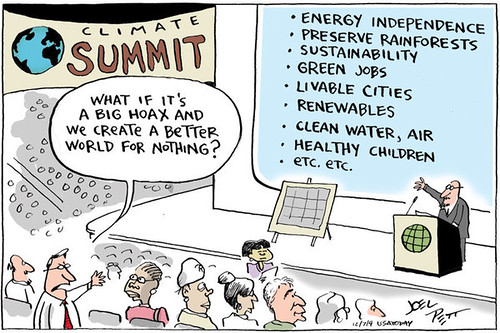
While Pascal's Wager is a theologically flawed argument, the principle has applications in other aspects of life, such as investment and betting — purely because the game theory aspects are reasonable — and Pascal's Wager is brought up by name as an analogy where such gain/loss comparisons can be made. In short, it presents a way of dealing with uncertainty by assessing not probability but only the magnitude of potential gains against losses. In the "global warming wager",[7] the comparison is made between trying to help the environment and not helping the environment. Regardless of whether you believe global warming is a scam or hoax (and regardless of whether you're right), the best outcome is still to protect the environment — a.k.a. "what if it's a big hoax and we create a better world for nothing?"[8]
In the Wager, believing in God produces the larger gain whereas not believing produces the greater losses. This principle of comparing potential gains and losses is a way of ensuring against black swan like events ("fragility" and "anti-fragility" according to Black Swan author Nassim Taleb) particularly in economics. For example, placing 100% of your funds into a single investment leads to a possible loss—regardless of the odds, which may be unknowable—of 100% of your funds. Such an event would be a greater loss than if you spread your funds over many investments where a single failure is not devastating but your chances of success are slightly increased. The actual probabilities are irrelevant; it is simply a way of shoring yourself up against the off-chance that you're unlucky. The question asks which route avoids the worst possible outcomes.
The same thinking lies behind solutions to the prisoner's dilemma. Viewing unknown events through the eyes of Pascal's Wager eliminates the need to understand the probabilities behind events because decisions can be made by maximizing potential benefits and minimizing the harms. Indeed, this is the very point of the Wager if it is stripped of its theological implications.
As an evangelical tool[edit]
Like most arguments used by apologetics, it seems more about reassuring existing believers than converting non-believers. This is because in order to convince a non-believer, a theological argument must both prove that the god it argues for is the One True God and disprove all other possibilities. People lacking a belief can see the potential for multiple gods existing, in fact an infinite number, but believers tend to be constrained by an existing view that either their god exists, or no god does. Only in this latter case does the reasoning behind Pascal's Wager make any sense.[note 5]
In a nutshell[edit]
See also[edit]
- Agnostic atheism
- Christianity is not a religion
- Cryonics — they're very fond of Pascal's wager
- List of gods that theists don't believe in — And by doctrine, you can't believe in ALL of them.
- RationalWiki:FAQ for the Newly Deconverted
- Garbage in garbage out — where Pascal's wager is used as an example
- Roko's basilisk — a modern-day version
- Russell's Teapot
- Fun:Where will you go after you die — Your fate in the afterlife according to several major faiths and philosophies depending on your beliefs.
External links[edit]
- Pascal's Pensées. (The Wager is found in Pensée 233.)
- Vatican announces results of Pascal’s Wager
- Pascal's Wager at the Stanford Encyclopedia of Philosophy
- Pascal's wager, a refutation
- Pascal's Mugging
- An invocation of this wager at "de-conversion", a site for recovering believers.
- A response to an agnostic atheism wager — no, not particularly good.
- What If You're Wrong? A DarkMatter2525 cartoon where a Christian finds out that Islam is the "true" religion.
Notes[edit]
- ↑ Windows 10, of course, would be in Hell.
- ↑ Even in Milton's Paradise Lost Pandemonium is a very happening joint with debate clubs, sex parties, and demon Olympics. At least until all of the human sinners showed up and started wrecking the place with their whining. Then again, John Milton was a dyed-in-the-wool Puritan, so this might have been pretty horrific to him personally.
- ↑ Not to mention that, as in eternity everything will sooner or later happen, you'll end screwing up while in Heaven and will be sent to Hell — unless you were brainwashed as commented further, and even that is not a guarantee.
- ↑ Either that or Hades decides it's time to expand the Asphodel Fields due to overcrowding (at least asphodels are pretty and their fruits edible) or simply quits his job burned out of it, goes with his wife Persephone to live to a much nicer place, and the Underworld gets a new management that decides to change things.
- ↑ Ironically, this reasoning was in fact inapplicable in Biblical times, when the Bible specifically remonstrated against believing in Baal — which, confusingly, was not a specific god per se, but a generic term for any local god in the polytheistic milieu of the time.
References[edit]
- ↑ 1.0 1.1 Stanford Encyclopedia of Philosophy — Pascal's Wager
- ↑ The Necessity of the Wager — read it and weep.
- ↑ Dresden Codak: Secular Heaven
- ↑ War In Heaven
- ↑ The Future of an Illusion, part VI.
- ↑ Michael Shermer, The Believing Brain: From Ghosts and Gods to Politics and Conspiracies — How We Construct Beliefs and Reinforce Them as Truths, page 45.
- ↑ http://www.youtube.com/watch?v=mF_anaVcCXg
- ↑ http://farm5.static.flickr.com/4036/4254681996_27b1ed7ff0.jpg